March Books.

March Books

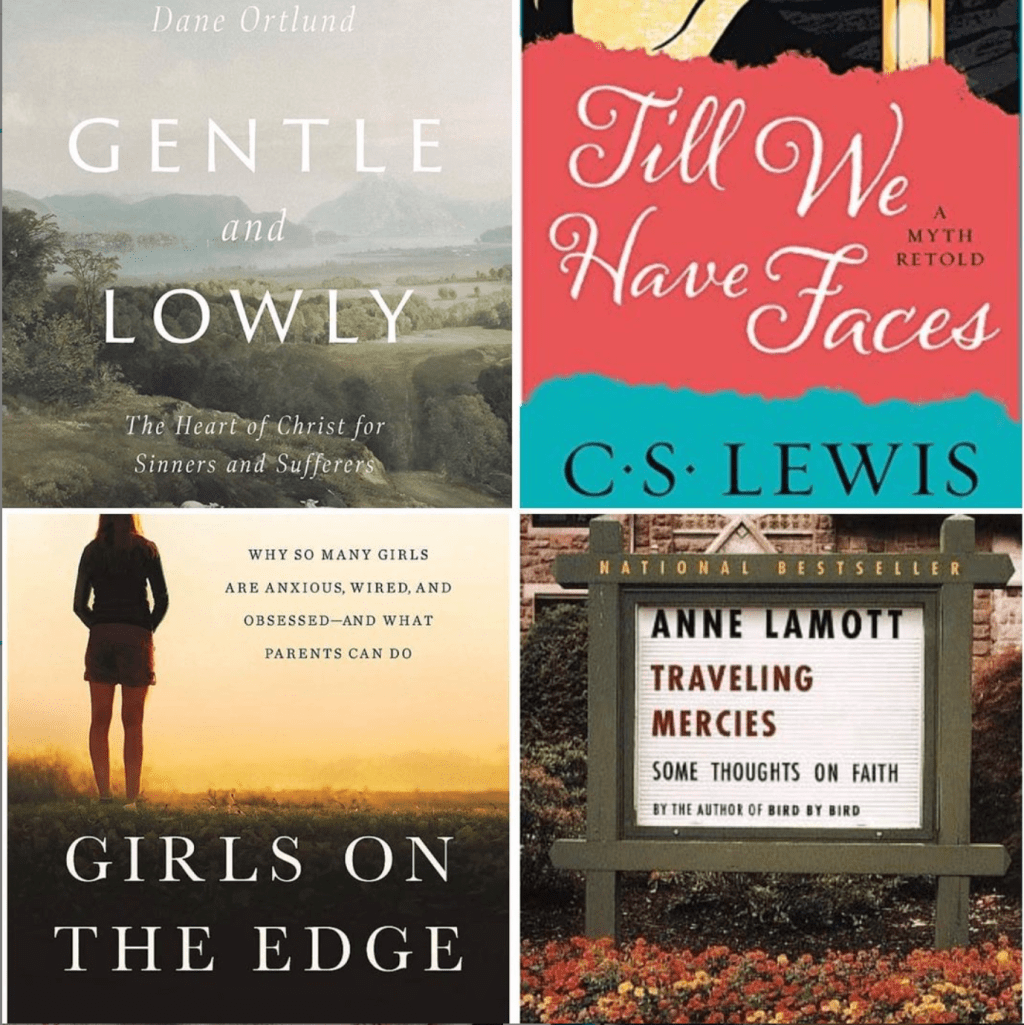
Gentle and Lowly by Dale Ortlund — Probably one of my favorite parenting books. It’s not about parenting at all, but it has helped me tremendously as a parent. It’s taught me how to be a more patient parent to my children by showing in detail throughout the Bible how much patienct, mercy, and grace God has with His children. It’s definitely a book I will be rereading annually.

Till We Have Faces by C.S. Lewis — Based on the myth of Cupid and Psyche, this is a book that was hard to push through, but it was worth it. C.S. Lewis shares his philosophy on envy, betrayal, and love. I love his books because they are so rich with ideas that often make me just stop mid-page and think about what I just read. One of my favorite quotes I’ve read in a long time came from this book, about longing for death not out of despair, but out of joy, a hope that somewhere a better place than this one exists and we will go there someday.

Traveling Mercies by Anne Lamott — I love Anne Lamott so much for her honest writing. She doesn’t pretend to have everything together, but simply invites her readers into her messy life, and writes in a way that makes you feel less weird about your own messy life. Traveling Mercies was all about her journey to faith in Christ and her thoughts on hypocrisy in faith.

Girls on the Edge by Leonard Sax — The subtitle of this book is Why So Many Girls Are Anxious, Wired, and Obsessed – and What Parents Can Do. This book was good at pointing out the areas that we as a culture our failing our daughters: sexualization, chemical exposure, too much technology/social media – and what we can do as parents to protect them from growing up too fast, both literally and figuratively (enforce modesty, change their diet, limit technology). I always love Sax’s parenting books because he encourages parents to apply their authority for the well-being of our kids. To hesitate our authority is to put our children at risk.

Kitchen Renovation.

Right now our kitchen is torn apart and we are knee-deep sawdust. Apparently there is a difference between a ‘remodel’ and a ‘renovation’. A ‘remodel’ means changing the existing structure to be completely different from the original (think, tearing down walls, permits, contractors). ’Renovation’ sounds more exciting but really just means changing your existing stuff to look different (think: cheaper).

To save money on this renovation, we are doing nearly everything ourselves. First we ripped out the old tile, quite literally… I never realized how much prying and actual ripping was involved in removing tile. Yesterday we laid new counters. New sink goes in today. New tile goes up tomorrow. Then new cabinets get constructed, painted, hung. Then lighting. Then floors sanded and refinished. 

It’s a change I’ve wanted to make ever since we moved in to this house ten years ago, but then life happened. So much life. Ten years ago our sons were 3 and 2 and they were very busy little guys. At that time, we were still trying unsuccessfully at having a third child. I didn’t know then, but I was suffering from postpartum depression from a recent late-term miscarriage. Then foster care, then many, many foster babies and a few adoptions. Life kept marching on at high speed.

We find ourselves right now in an unfamiliar place: our sons are 13 and 12, very capable young men. And we are in the midst of a global pandemic that prohibits most activities outside the home. And so we are stuck in our home with nothing but time, a little extra money thanks to Mark’s job, and many able hands to help. And so we ripped out the tile. Soon we will have new shiny surfaces on which to make our quarantine sourdough and banana bread.

Life as an Education.

I have never let my schooling interfere with my education.” – Mark Twain

My oldest son is 13. He just finished up 8th grade last week and he’s already started on his freshman year through online high school. He’s eager for the next exciting chapter of life.

He has been homeschooled exclusively since … well? I want to say since kindergarten, but really his education began much earlier than that. It has its roots in the toddler who dug holes and made rivers in the sandbox. In the boy who stacked bricks leftover from a yard project into tall structures. We read lots of books, watched bugs, and made pancakes and bread together.

When school did officially start in kindergarten at age 6, it was an event hardly worth noticing. We would do some counting work, practice writing letters, and maybe a craft once a week. That lasted about 30 minutes a day, which even then was pushing his 6-yr old attention span. And to be honest, there were many days we didn’t even do this. Many days were simply spent outside. Children don’t necessarily have to ‘do’ school every single day to leap forward in their learning. The hard thing is getting our busywork out of the way so they can do the real learning.

This ‘method’ was born a little bit out of a philosophy of education that says that children should have short, focused lessons when they are very young and plenty of time to play. But it was also born in large part because he was a very active, emotional, hyper kid. In other words, a normal boy.  

As his attention span, his abilities, and his curiosity grew, our lessons grew a little longer, but still not by much. It wasn’t until about 5th grade that his assignments ramped up slowly. I gave him some say in what books he read for science and history, and made sure he wrote a paragraph every day summarizing something he’d read that day. By this time “school” took him a solid 2.5 hours, including music practice, math, reading, and handwriting. 

It was around this time that we took an entire year off. It was the year our foster daughter, then one-and-a-half, spent a month in the intensive care unit at Stanford Children’s Hospital as a result of an E. Coli infection. Then she got diabetes and we all needed to learn how to care for her. Then I found out I was pregnant and had about four months of near-constant exhaustion and intense mood swings.

That year our school was beach days, audiobooks, and nature walks. We did nearly nothing in the way of “real school”. And yet, when I felt well enough to resume a bit of structure and we resumed our lessons, I found that he hadn’t missed anything at all. He ‘caught up’ quickly in math (in quotes because, caught up to whom?). And when he took his first standardized test (the Iowa Assessment) just a year ago, he tested above grade level in nearly all subjects.

The middle school years were preparation for high school: He had even more say in the books he read. (One of his science books was What Einstein Told His Cook: Kitchen Science Explained, perfect for a young physics lover who enjoys cooking.) I think because I listened to his interests, he was more willing to read the books I’d place on his stack. He learned how to budget his time. Look online for answers to math questions when they weren’t readily apparent. Persevere through a very difficult math concept. School was challenging, but he was mature enough to accept the challenge. Schoolwork took him about 3-4 hours a day.

As I reflect back on these nine years of homeschooling my son, I don’t wish we did more. In fact, I wish I’d pushed a little less and had a little more patience. I wish I could have dropped the guilt of “not doing enough”, because now I see that we did just enough. I feel grateful to have had the opportunity to watch the process of this squirrelly little boy of mine flourish into a young man ready to take charge of his own education.

If your kids are just wrapping up their school year and you’re considering what the world will look like as they head (maybe) back to school in August, consider homeschooling. It’s a suprisingly wonderful experience. It’s difficult at times, but so full of joy as you and your child grow and learn together.

Some books to inspire: 

The Call of the Wild and Free: Reclaiming Wonder in Your Child’s Education by Ainsley Arment

For the Children’s Sake by Susan Schaeffer MacAulay

The Unhurried Homeschooler by Durenda Wilson

Metamorphosis.

Nothing prepared me for the metamorphosis that has begun in my oldest son. He’s 13 and growing constantly. Deepening voice, arms and legs that seem to not quite belong to him. He now stands a head taller than me. He’s trying on grownup ideas. Watching us closely and questioning. Detecting any hints of hypocrisy in our actions, inconsistences in the things we’ve taught him over the years.

Some delightful surprises are the conversations we’re having about life: what it means to be a man, to be a protector and provider for a family. How to spend money. How to choose a career path. And a new phase of maturity, a desire to do the right thing, even if the practice isn’t quite perfect.

If I could have glimpsed this lanky capable son of mine back when he was still a 7 yr old sprite, how much patience I would have summoned, knowing what laid in store for him!