Top Three Resources for Adoptive Parents

So you’ve decided to jump into the world of adoption. 

Maybe you’re still wading through your paperwork pregnancy. Perhaps you’re waiting on a match. Or maybe you’ve already brought your new child home. 

You’re probably dreaming of what life will be like with your new addition. If you’re anything like me, you may have one or two bio kids and think you’ve got this parenting thing down. Your kids may be (generally) well behaved, sleeping through the night, and hitting their milestones on time. How hard can it be?

You need to know that parenting children from adoption is different from parenting biological children. Adoption always involves trauma. Please read that again and let it sink in. Adoption always involves trauma.

Why is there trauma? Because even in the very best case, where a healthy birth mother has a stress-free pregnancy and makes an adoption plan that includes her child being transferred to their adoptive parents at birth, there is separation. The baby knows his mother’s unique voice and heartbeat. It is a jarring transition when he is removed from that familiar environment. 

If you’re adopting from foster care, there is likely some combination of abuse, neglect, exposure to domestic violence, and in-uterine drug and alcohol exposure in the child’s history. Getting even a young infant doesn’t mean they are trauma-free. One of our daughters came to us at six months old and already had been exposed prenatally to drugs and alcohol, and had experienced periods of neglect. This is all trauma. 

If you are adopting internationally, the child has likely experienced periods of neglect, parental loss, and possibly stressful medical care. These experiences cause permanent changes in the brain, leading to verbal/auditory processing issues, sensory problems, executive function challenges, and even learning disabilities later in childhood.

This means that we need to parent differently than conventional parenting books suggest. For example, we may use time-outs as a tool for changing behavior with a typical child. A toddler hits a sibling, and so we put him in the time-out chair for a few minutes. For a child with trauma in their background, this may trigger feelings of abandonment, compound the problem, and cause even more behavior challenges. We need to parent with brain science in mind. Here are the best resources I have found for this job.

Resources

1. The Connected Child by Karyn Purvis, Ph.D. and David Cross Ph.D. – 

This book is invaluable to any adoptive parent, even if you’ve had your child home for years. The basis is Trust-Based Relational Intervention (TBRI), a way of relating to children based on meeting their physical and attachment needs and learning ways to calm fear-based behaviors.

The authors cover the brain science behind our children’s behaviors and offer practical advice for handling it. As the title suggests, it places a significant emphasis on connection, believing that a child wants to do well and will do their best when they feel safe and securely attached to their parent. 

It covers concepts like felt safety, the IDEAL response, and re-dos. It has suggestions for supporting the child’s sensory needs to (support) cooperative behavior. It emphasizes mutual respect: speaking to your child with respect and teaching them how to communicate with others with respect. 

2.The Connected Parent by Karyn Purvis, Ph.D. and Lisa Qualls

This book is similar to The Connected Child in that it uses the same TBRI principles, but the emphasis is on walking the techniques out on a day-to-day basis. It is co-authored by Lisa Qualls, a foster parent and mom to twelve children by birth and adoption. She has lived these principles out with her children for the past fifteen years, so she understands how hard it can be. One of the best aspects of this book is the idea of using scripts with our kids, which are short phrases aimed at redirecting children to better behavior. They really work every time we use them. 

What struck me most about this resource is that the authors don’t just give advice for the kids but also offer grace for the parent. They remind us that this journey of parenting adopted children is a marathon, not a sprint. If we are to parent well, we need to keep our needs in mind and even seek professional help if we need it. 

3. What Happened to You? by Bruce D. Perry, M.D., Ph.D., and Oprah Winfrey

The longer I parent, the more I realize how my upbringing affects my parenting instincts and decisions. Sometimes we don’t realize how our adverse experiences unconsciously inform how we parent. This book dives deep into the brain science behind behavior and offers wisdom for dealing with our own and our children’s issues.

I listened to the audiobook version and enjoyed the back and forth conversation between Perry and Winfrey. But I also got the hardcover version to take notes and mark it up. It is so full of valuable information!
2021 Book Roundup

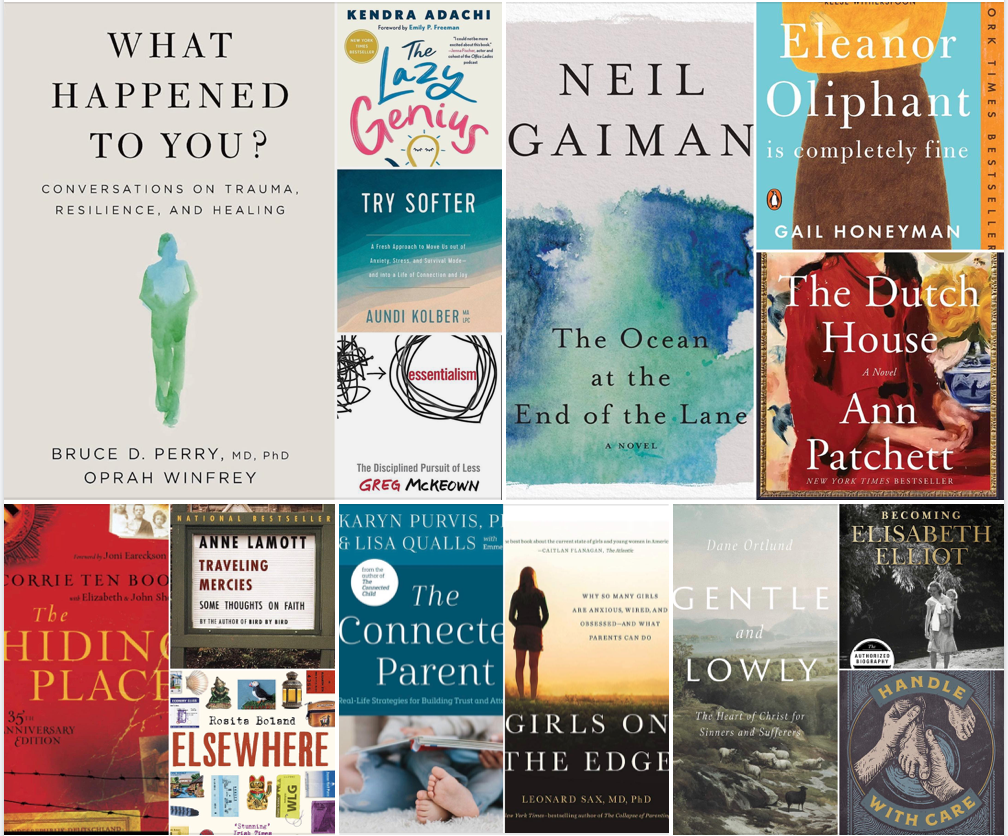
My favorite books of 2021! 📚

General Nonfiction

What Happened to You by Oprah Winfrey, Bruce D. Perry, et al.

The Lazy Genius Way by Kendra Adachi

Try Softer by Aundi Kolber

Esssentialism by Greg McKeown

Fiction

The Ocean At the End of the Lane by Neil Gaiman

Eleanor Oliphant is Completely Fine by Gail Honeyman

The Dutch House by Anne Patchett (specifically the audiobook read by Tom Hanks)

Memoir

Elsewhere by Rosita Boland

Traveling Mercies by Anne Lamott

The Hiding Place by Corrie Ten Boom

Parenting

The Connected Parent by Karyn Purvis and Lisa Qualls

Girls on the Edge by Leonard Sax

Spiritual

Gentle & Lowly by Dane Ortland

Becoming Elisabeth Elliot by Ellen Vaughn

Handle with Care by  Lore Ferguson Wilbert

I’ve had a few questions about how to find time to read. It is tricky with six kids.

• We still have quiet time on school breaks and weekends. That’s when I do a lot of reading. I need that time to recharge and so do my kids!

• I read for about 20 minutes before bed.

• Since we moved and had to purge a lot of things, I’ve been reading a lot of books on my kindle. Libby is a great app to borrow e-books free from your local library. I bring my kindle if I know I’m going somewhere that I’ll have to wait, so instead of mindlessly scrolling on my phone (which I definitely still do), I’ll bring up the kindle app and get a few minutes of reading.

• Audiobooks!! I’ve been using noise-cancelling headphones to listen to so many audiobooks. You can speed up the reading rate (the fastest I can go is 1.75). Your brain gets used to the faster reading so that normal speed sounds incredibly slow. These are my favorite budget noise-canceling headphones.

December Reads

Even though it was the month of December and I was busy with holiday preparations, I managed to read a ton! To be totally honest, it was probably because my kids were home from school for two solid weeks and I went on a lot of walks with my audiobooks.

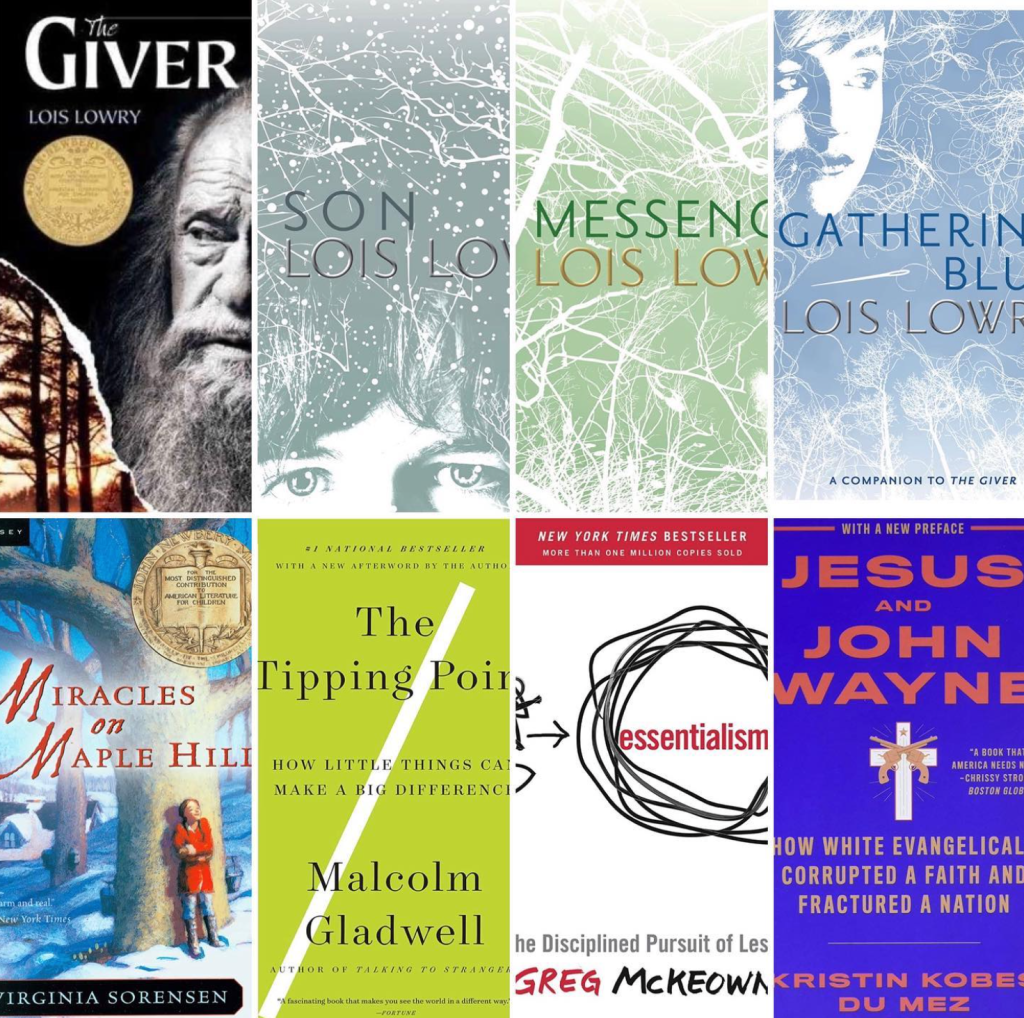
The Giver Quartet: The Giver, Gathering Blue,Messenger, and Son by Lois Lowry — I read The Giver in middle school and remembered it to be part thought-provoking, part very disturbing. Now my middle school son was assigned to read it. He got hooked on the whole series, and pulled me in.

One idea that keeps popping up in the books I’ve been reading in the past few months is the idea that productivity equals value. In our culture people are valued for the productiveness that they bring. If they are disabled, a child, or elderly, and they can’t contribute much, they generally don’t hold much value in the eyes of society. It’s the first thing that usually comes up in conversation: “What do you do?” If you don’t “do” something, the conversation stalls out and you end up talking about the weather, if you’re lucky.

The society in The Giver valued productivity to such an exaggerated degree that it can’t help but shine a reflection on us. How can we change this? How can we learn to value people simply because they are, not for what they can do? I believe these questions are at the heart of why our society is slow to embrace those groups who need a little help, whether because of mental illness, disability, or age.

The Tipping Point by Malcolm Gladwell — Another book that turned out to be very interesting and thought-provoking despite the topic being something I’d never even thought about before: how trends get started, catch on, and become viral. The book was written over 15 years ago, before the age of social media, and I think an update (or even a companion book) on the same topic would be valuable.

Jesus and John Wayne by Kristin Kobes Du Mez — This book was recommended by a friend. The author was provoked to this topic by the election of Donald Trump in 2016. She asks the questions, “How did a libertine who lacks even the most basic knowledge of the Christian faith win 81 percent of the white evangelical vote in 2016? And why have white evangelicals become a presidential reprobate’s staunchest supporters?” I’ve wondered these same things myself, and after reading her book, it makes a lot more sense. Plus, I gained a healthy wariness of Christian leaders that seem wholesome, but often are harboring ugly sin.

Essentialism by Greg McKeown — One of the best books I’ve read this year. It’s basically a how-to for Marie Kondo-ing your life (rather than your sock drawer). There were many take aways, like “To discern what is truly essential we need space to think, time to look and listen, permission to play, wisdom to sleep, and the discipline to apply highly selective criteria to the choices we make.” After reading this, I cut things out of my schedule and honestly haven’t missed them!

Miracles on Maple Hill by Virginia Sorensen — Another book that I read as a child and loved. Now that I’m an adult, I appreciate so much more about it that I missed as a child. It’s the story of a family who relocates from the city to the countryside of Vermont, as the father is trying to recover from PTSD after World War I (I totally missed that part as a kid!). The family finds peace and healing in the simplicity of being in the country, and Marly gets her dad back.

November Reads

November Reads… It was a good month for reading! About half these titles were read thanks to my new noise-cancelling headphones and the Libby app where you can borrow audiobooks from the library. 

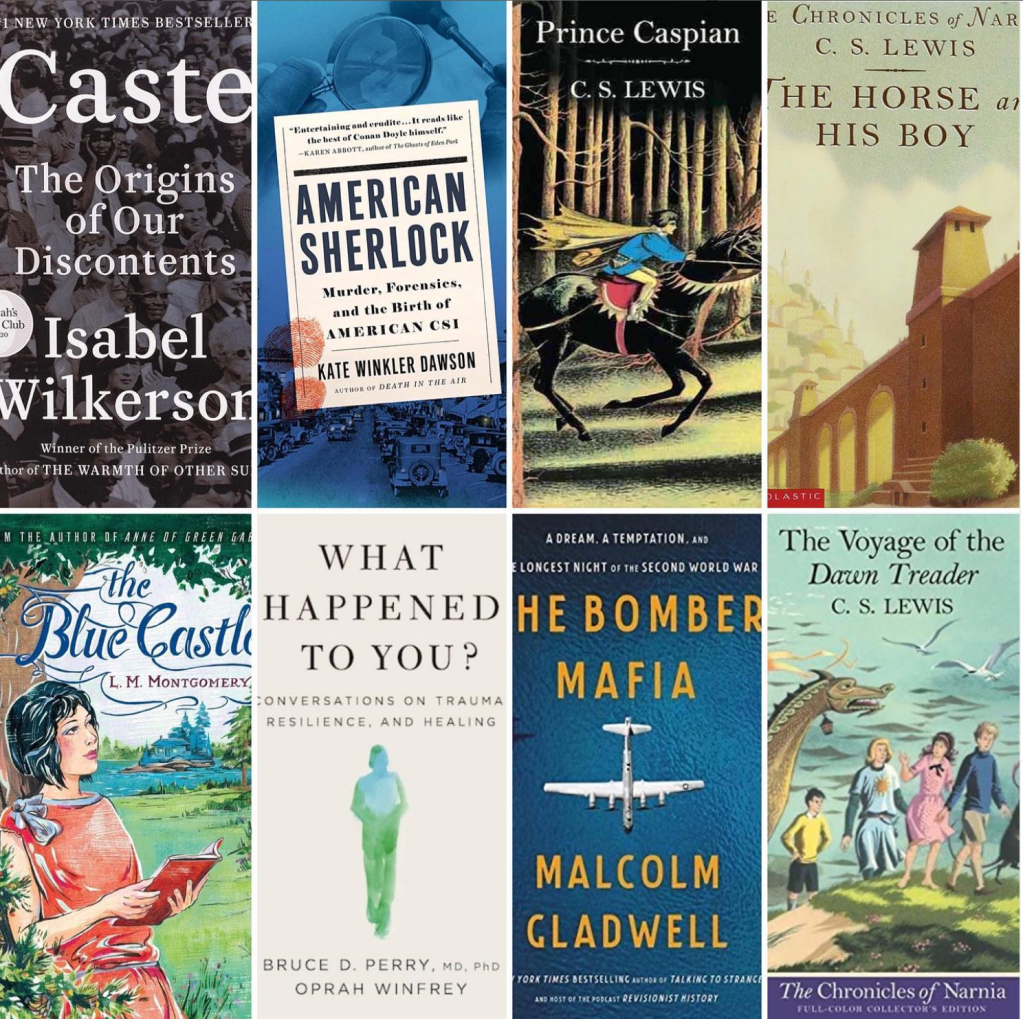
Caste by Isabel Wilkerson — I actually didn’t know what this book was about before I started it. I vaguely assumed it was about the Indian caste system, perhaps explaining how the system kept its structure even after immigration to the US (maybe a good idea for a book?). Instead, it was about how racism in America is actually a caste system. Consider this quote: “Caste is the granting or withholding of respect, status, honor, attention, privileges, resources, benefit of the doubt, and human kindness to someone on the basis of their perceived rank or standing in the hierarchy.” It was definitely eye-opening and was a further course in my education on issues of race in our country.

American Sherlock by Kate Winkler Dawson — A fascinating history of the origin of forensics. It was mostly about Edward Oscar Heinrich, a brilliant and obsessive scientist at The University of Berkeley. I found myself equal parts in awe at his genius, but also a bit sad for his neglected family.

The Chronicles of Narnia: The Horse and His Boy, Prince Caspian, The Voyage of the Dawn Treader by C.S. Lewis — I’ve so enjoyed rereading the Narnia books. I read The Lion, the Witch, and the Wardrobe as a young child, and then the whole series in college fifteen years ago. My experience with reading childhood books over again is that you never really grow out of them, but rather grow into them. I’m amazed at how richer they are after reading them as an adult. I hope to finish the series in this upcoming year.

What Happened to You by Oprah Winfrey and Bruce D. Perry — I highly recommend this book for anyone interested in the brain science behind trauma. It’s been so helpful in understanding my kids with trauma backgrounds. But anyone with abuse, neglect, and trauma in their childhood will benefit.

The Bomber Mafia by Malcolm Gladwell — I absolutely love learning about things I know nothing about. I’ve loved every Gladwell books I’ve read. I knew absolutely nothing about the air bombing campaign of World War II, and I learned a lot about it. There are some critical reviews for this book, saying it’s long-winded, or pointless. I think it’s an enjoyable read if you don’t take it as seriously as a history textbook.

August Books

August was an interesting month of reading. Even though it was a crazy month, with getting five kids ready for a new school year and also moving my elderly mom out from Connecticut to Idaho. Even so, I had huge portions of time to read (like two 8-hour long flights!)

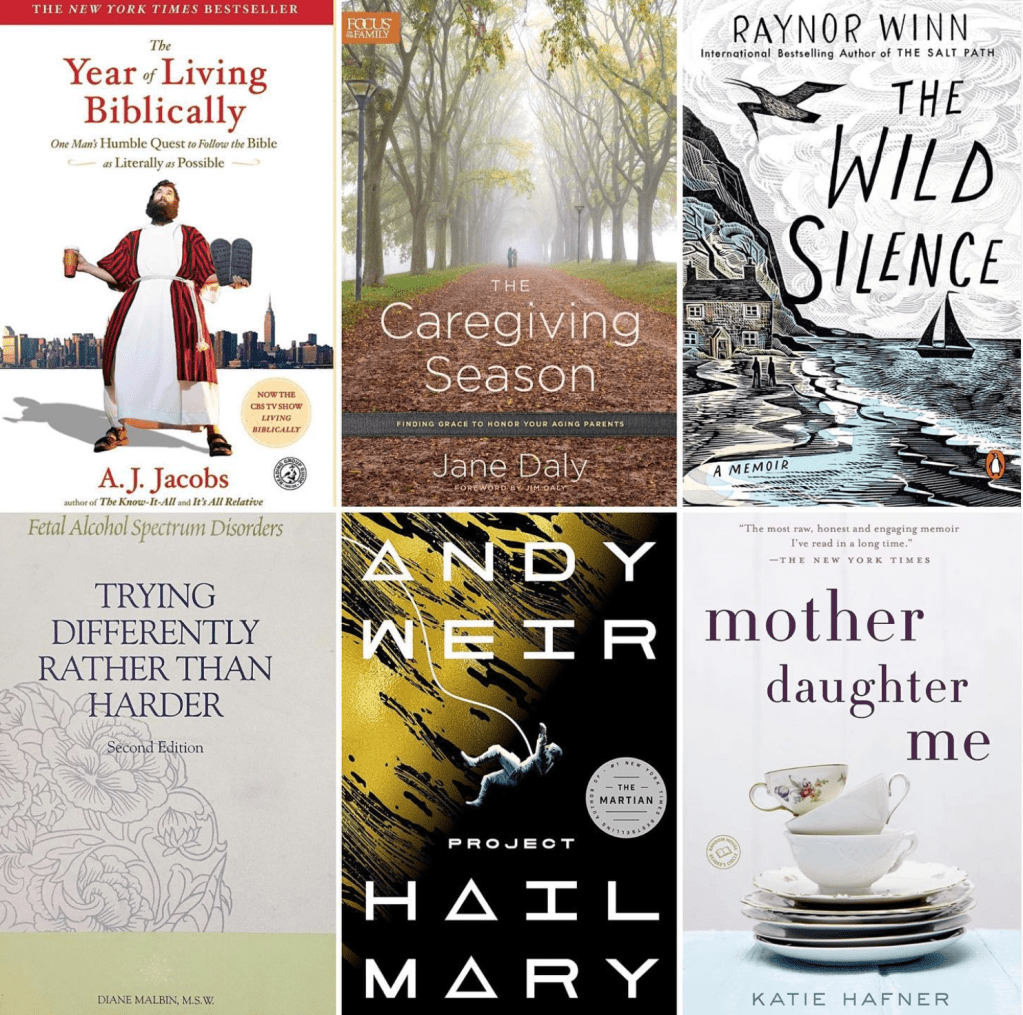
The Year of Living Biblically by A.J. Jacobs — This was a random thrift store find. It’s about a man who decides to live according to the Bible – as literally as possible – for a year. I had low expectations, figuring at best t was a lighthearted poke at the hard-to-understand parts of the Bible. But I found parts of it pretty fascinating. I learned about many Jewish rules in the Bible that people still follow today, like the admonition to not mix linen and wool (there is actually an expert in the field who travels to people’s homes and examines their garments to make sure there aren’t any offending fibers.) It was humorous, but also interesting.

The Caregiving Season by Jane Daly — A very encouraging book for anyone finding themselves suddenly thrown into the roll of caregiving for a parent. One of the best I’ve read so far.

The Wild Silence by Raynor Winn — The follow-up memoir to The Salt Path, which I loved. I found myself losing interest in this book. Like a hiker without a destination, it was more of a ramble without a clear objective.

Trying Differently Rather Than Harder by Diane Malbin — A book about the symptoms and strategies for managing behavior of people with Fetal Alcohol Syndrome Disorder. We learned just recently that it’s very likely that our 3 adopted children have FASD (and likely my mother as well). I read this book to try to fit in more pieces to puzzle of how to deal with behaviors that don’t respond to typical parenting. Highly recommended for any parent with a child on the FASD spectrum.

Project Hail Mary by Andy Weir — I almost never read sci-fi, but this one caught my attention because it came highly recommended by someone who also never reads sci-fi. It’s about a man who wakes up from a coma on a spaceship and slowly unravels memory to find his mission objective. There is a type of (space fungus? energy? matter?) that is sapping our sun’s energy, but not Tau Ceti’s, a star which is not being affected by the space fungus and is 12 light years away. He needs to figure it out and send the information back to earth before everyone on the planet dies in a planet-wide ice age. It reminded me of my high school days when I found theoretical physics discussions endlessly fascinating, dreaming of what possibilities lay ahead of us.

Mother Daughter Me by Katie Hafner — I love memoirs. I love learning about other people’s lives and the lessons they’ve taken away from their hard experiences. Since I’m going through my own journey with my mom, I found this memoir especially relevent. Katie’s book is about the year that she, her 16 year old daughter, and her elderly mother move into the same apartment. I was reassured by her description of having to confront her own emotions about her neglectful upbringing. There are so many up and down emotions involved with mothers and daughters, and this book was like chatting with a good friend going through a similar situation as myself.

March Books.

March Books

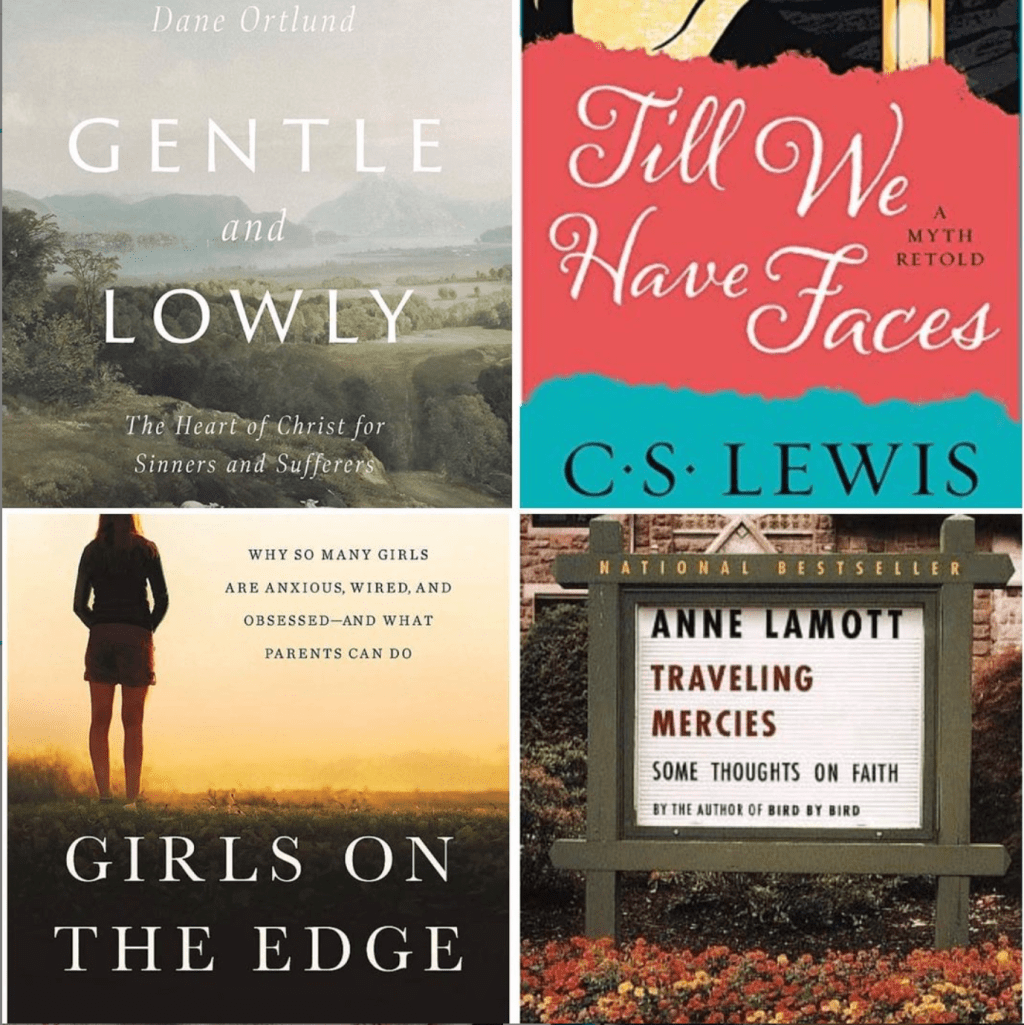
Gentle and Lowly by Dale Ortlund — Probably one of my favorite parenting books. It’s not about parenting at all, but it has helped me tremendously as a parent. It’s taught me how to be a more patient parent to my children by showing in detail throughout the Bible how much patienct, mercy, and grace God has with His children. It’s definitely a book I will be rereading annually.

Till We Have Faces by C.S. Lewis — Based on the myth of Cupid and Psyche, this is a book that was hard to push through, but it was worth it. C.S. Lewis shares his philosophy on envy, betrayal, and love. I love his books because they are so rich with ideas that often make me just stop mid-page and think about what I just read. One of my favorite quotes I’ve read in a long time came from this book, about longing for death not out of despair, but out of joy, a hope that somewhere a better place than this one exists and we will go there someday.

Traveling Mercies by Anne Lamott — I love Anne Lamott so much for her honest writing. She doesn’t pretend to have everything together, but simply invites her readers into her messy life, and writes in a way that makes you feel less weird about your own messy life. Traveling Mercies was all about her journey to faith in Christ and her thoughts on hypocrisy in faith.

Girls on the Edge by Leonard Sax — The subtitle of this book is Why So Many Girls Are Anxious, Wired, and Obsessed – and What Parents Can Do. This book was good at pointing out the areas that we as a culture our failing our daughters: sexualization, chemical exposure, too much technology/social media – and what we can do as parents to protect them from growing up too fast, both literally and figuratively (enforce modesty, change their diet, limit technology). I always love Sax’s parenting books because he encourages parents to apply their authority for the well-being of our kids. To hesitate our authority is to put our children at risk.

February Books.

I always have at least three books going at a time, but usually as many five or six. I read a few minutes from each one every day, and by the end of the month it really adds up! This month I cut back my internet time and (shocker) had so much extra time to read. I even splurged on a kindle/audible combo for one book so I could switch back and forth between them as time allowed. 

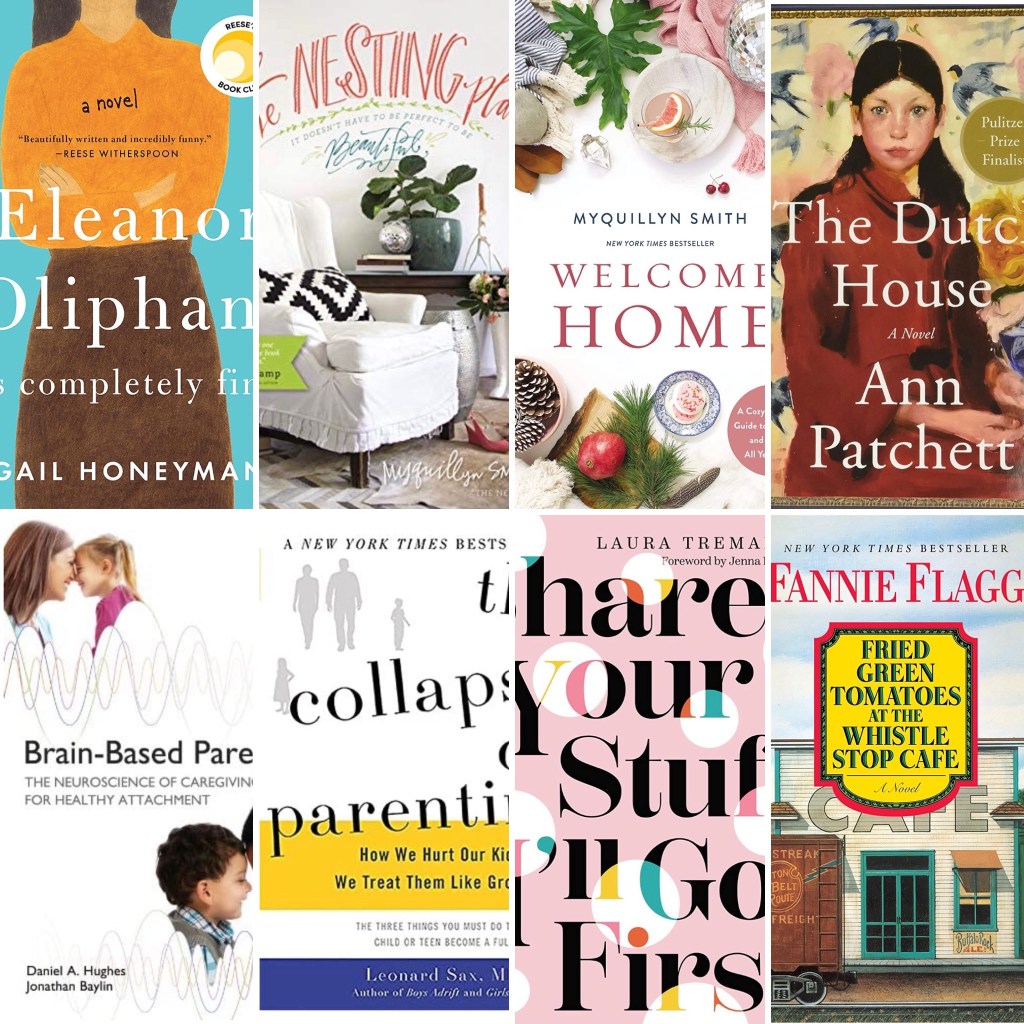
Eleanor Oliphant is Completely Fine – by Gail Honeyman — I actually thought this was another book when I started reading it. Then I thought I knew where the story was going. But it ended up being a completely different story than I thought it was going to be at the beginning. It’s about a woman who slowly unravels the trauma of her childhood, makes peace with her past, and grows into a mature friendship. 

The Nesting Placeby Myquillyn Smith — I’m in the middle of packing, purging, and taking the opportunity of a new nest to make some fresh changes. So I’m on the lookout for ideas for creating cozy, comfortable space in our new home. The author has lived in 14 homes in 18 years, so she knows about creating a home out of a house. Biggest takeaways: Limitations are a good thing. Things like a small budget, or a weird house layout, or a rental home that you can’t change are good things. Having too many options can be paralyzing. Every home has potential, if you just embrace it. 

Welcome Home – by Myquillyn Smith — More about making a home stylish and cozy, but more focused on minimalism and using each season to inspire style. 

The Dutch House – by Ann Patchett — A story about a brother and sister and the huge, elegant house they grew up in until their father died and their stepmother kicked them out. Together they navigate adulthood, relationships, and ultimately forgiving their estranged mother. I listened to this on Audible (read by Tom Hanks) and enjoyed it. There isn’t much of a plot, so it’s one of those books where you listen to people’s thoughts about life. I happen to love this kind of book, but I know it drives some people crazy.

The Collapse of Parenting – by Dr. Leonard Sax – My favorite read of the month. Key points: 1. Teach kids humility. They are not the center of the family (some of my people need this reminder!) 2. Conscientiousness and self control are the best predictors of adult success 3. Enforce good habits, don’t wait for your kids to want to do the right thing. “We are what we repeatedly do. Excellence then, is not an act, but a habit.” This book was a much needed course correction for our parenting. 

Brain-Based Parenting: The Neuroscience of Caregiving for Healthy Attachment – by Daniel A. Hughes — High recommended by adoption specialists. This one took me all month to read because of how dense it was, but it was well worth it. It helped me understand a lot about attachment dynamics and had a lot of helpful advice for dealing with challenging behaviors. 

Share Your Stuff, I’ll Go First – by Laura Tremaine — A guide to being a more open friend and inviting others’ stories into your life. I’m super introverted and usually think people don’t care so much about what’s going on in my life, but according to Laura, when you ‘share your stuff’ it invites others to share their stuff, and deeper friendships are the result. Thanks to the pandemic I haven’t had the chance to test out this theory yet, so we shall see. 

Fried Green Tomatoes at the Whistle Stop Cafe – by Fannie Flagg — Just like the movie but so much better.