Top Three Resources for Adoptive Parents

So you’ve decided to jump into the world of adoption. 

Maybe you’re still wading through your paperwork pregnancy. Perhaps you’re waiting on a match. Or maybe you’ve already brought your new child home. 

You’re probably dreaming of what life will be like with your new addition. If you’re anything like me, you may have one or two bio kids and think you’ve got this parenting thing down. Your kids may be (generally) well behaved, sleeping through the night, and hitting their milestones on time. How hard can it be?

You need to know that parenting children from adoption is different from parenting biological children. Adoption always involves trauma. Please read that again and let it sink in. Adoption always involves trauma.

Why is there trauma? Because even in the very best case, where a healthy birth mother has a stress-free pregnancy and makes an adoption plan that includes her child being transferred to their adoptive parents at birth, there is separation. The baby knows his mother’s unique voice and heartbeat. It is a jarring transition when he is removed from that familiar environment. 

If you’re adopting from foster care, there is likely some combination of abuse, neglect, exposure to domestic violence, and in-uterine drug and alcohol exposure in the child’s history. Getting even a young infant doesn’t mean they are trauma-free. One of our daughters came to us at six months old and already had been exposed prenatally to drugs and alcohol, and had experienced periods of neglect. This is all trauma. 

If you are adopting internationally, the child has likely experienced periods of neglect, parental loss, and possibly stressful medical care. These experiences cause permanent changes in the brain, leading to verbal/auditory processing issues, sensory problems, executive function challenges, and even learning disabilities later in childhood.

This means that we need to parent differently than conventional parenting books suggest. For example, we may use time-outs as a tool for changing behavior with a typical child. A toddler hits a sibling, and so we put him in the time-out chair for a few minutes. For a child with trauma in their background, this may trigger feelings of abandonment, compound the problem, and cause even more behavior challenges. We need to parent with brain science in mind. Here are the best resources I have found for this job.

Resources

1. The Connected Child by Karyn Purvis, Ph.D. and David Cross Ph.D. – 

This book is invaluable to any adoptive parent, even if you’ve had your child home for years. The basis is Trust-Based Relational Intervention (TBRI), a way of relating to children based on meeting their physical and attachment needs and learning ways to calm fear-based behaviors.

The authors cover the brain science behind our children’s behaviors and offer practical advice for handling it. As the title suggests, it places a significant emphasis on connection, believing that a child wants to do well and will do their best when they feel safe and securely attached to their parent. 

It covers concepts like felt safety, the IDEAL response, and re-dos. It has suggestions for supporting the child’s sensory needs to (support) cooperative behavior. It emphasizes mutual respect: speaking to your child with respect and teaching them how to communicate with others with respect. 

2.The Connected Parent by Karyn Purvis, Ph.D. and Lisa Qualls

This book is similar to The Connected Child in that it uses the same TBRI principles, but the emphasis is on walking the techniques out on a day-to-day basis. It is co-authored by Lisa Qualls, a foster parent and mom to twelve children by birth and adoption. She has lived these principles out with her children for the past fifteen years, so she understands how hard it can be. One of the best aspects of this book is the idea of using scripts with our kids, which are short phrases aimed at redirecting children to better behavior. They really work every time we use them. 

What struck me most about this resource is that the authors don’t just give advice for the kids but also offer grace for the parent. They remind us that this journey of parenting adopted children is a marathon, not a sprint. If we are to parent well, we need to keep our needs in mind and even seek professional help if we need it. 

3. What Happened to You? by Bruce D. Perry, M.D., Ph.D., and Oprah Winfrey

The longer I parent, the more I realize how my upbringing affects my parenting instincts and decisions. Sometimes we don’t realize how our adverse experiences unconsciously inform how we parent. This book dives deep into the brain science behind behavior and offers wisdom for dealing with our own and our children’s issues.

I listened to the audiobook version and enjoyed the back and forth conversation between Perry and Winfrey. But I also got the hardcover version to take notes and mark it up. It is so full of valuable information!
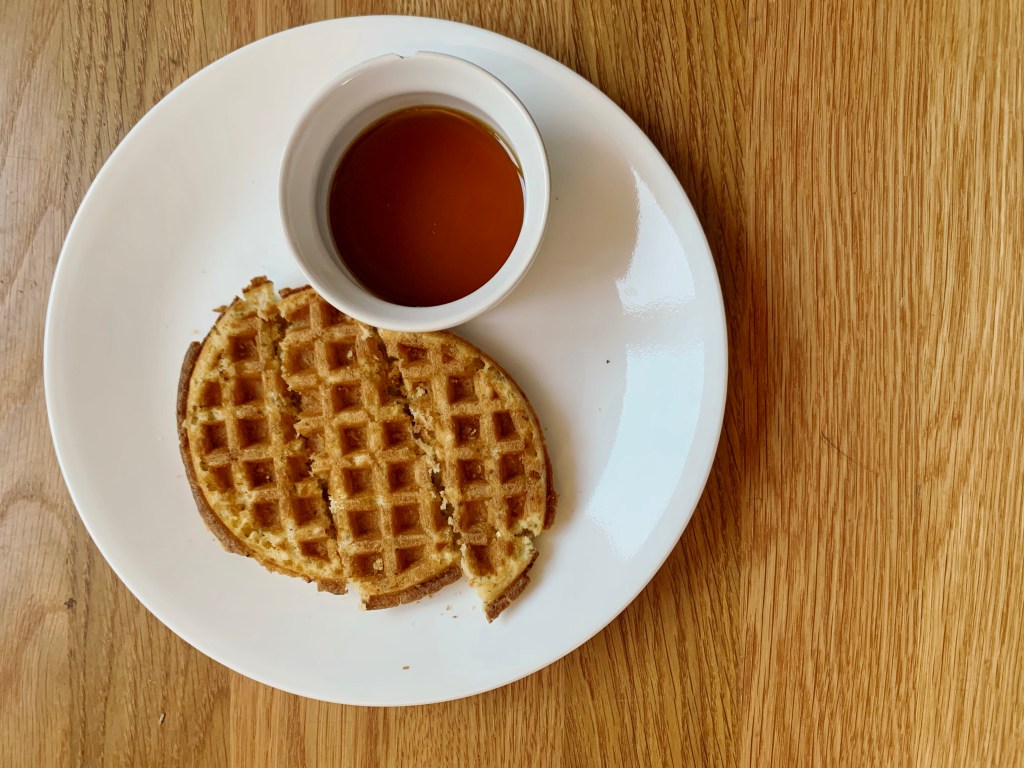
Trauma and a Waffle.

Many people think that when you adopt a child as a young baby and give them lots of love and attention and do all the right things to form a healthy attachment, that it’s enough to cover any problems.

What a lot of people don’t realize is that problems begin before the child even breathes their first breath. A mother’s stress hormones during pregnancy affect her child’s brain development immensely. Drinking alcohol during pregnancy physically damages the brain and creates an injury that lasts a lifetime.

This innocent waffle caused an hour-long rage before school this morning because it wasn’t the right color or texture.

My child has a difficult time regulating her emotions and so very small things become VERY BIG THINGS. It’s tempting to assume “Oh, they’re just being a brat” or that their behavior is a result of some failing on my part as a parent.

The more I learn about trauma and brain science, the more compassion I can have for my child and the more I can show her patience. It’s not easy and I’m always learning more.

The Connected Parent” by Karyn Purvis and Lisa Qualls has been an amazing resource, as well as watching TBRI videos on YouTube.

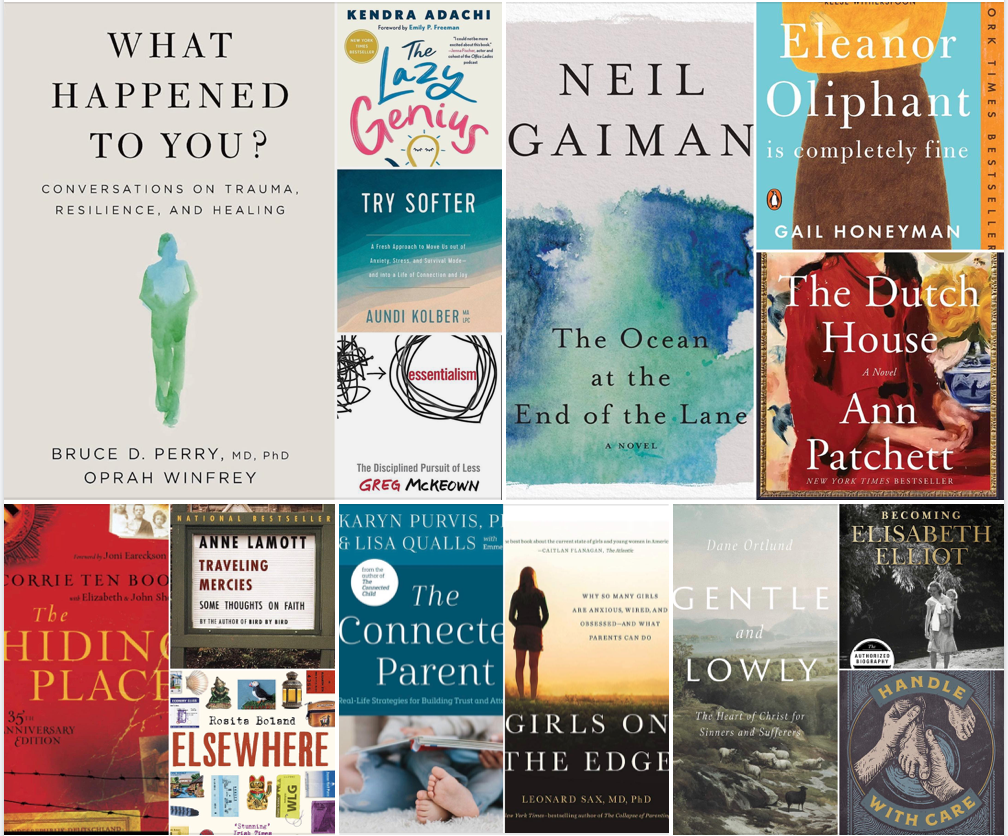
2021 Book Roundup

My favorite books of 2021! 📚

General Nonfiction

What Happened to You by Oprah Winfrey, Bruce D. Perry, et al.

The Lazy Genius Way by Kendra Adachi

Try Softer by Aundi Kolber

Esssentialism by Greg McKeown

Fiction

The Ocean At the End of the Lane by Neil Gaiman

Eleanor Oliphant is Completely Fine by Gail Honeyman

The Dutch House by Anne Patchett (specifically the audiobook read by Tom Hanks)

Memoir

Elsewhere by Rosita Boland

Traveling Mercies by Anne Lamott

The Hiding Place by Corrie Ten Boom

Parenting

The Connected Parent by Karyn Purvis and Lisa Qualls

Girls on the Edge by Leonard Sax

Spiritual

Gentle & Lowly by Dane Ortland

Becoming Elisabeth Elliot by Ellen Vaughn

Handle with Care by  Lore Ferguson Wilbert

I’ve had a few questions about how to find time to read. It is tricky with six kids.

• We still have quiet time on school breaks and weekends. That’s when I do a lot of reading. I need that time to recharge and so do my kids!

• I read for about 20 minutes before bed.

• Since we moved and had to purge a lot of things, I’ve been reading a lot of books on my kindle. Libby is a great app to borrow e-books free from your local library. I bring my kindle if I know I’m going somewhere that I’ll have to wait, so instead of mindlessly scrolling on my phone (which I definitely still do), I’ll bring up the kindle app and get a few minutes of reading.

• Audiobooks!! I’ve been using noise-cancelling headphones to listen to so many audiobooks. You can speed up the reading rate (the fastest I can go is 1.75). Your brain gets used to the faster reading so that normal speed sounds incredibly slow. These are my favorite budget noise-canceling headphones.

October Books

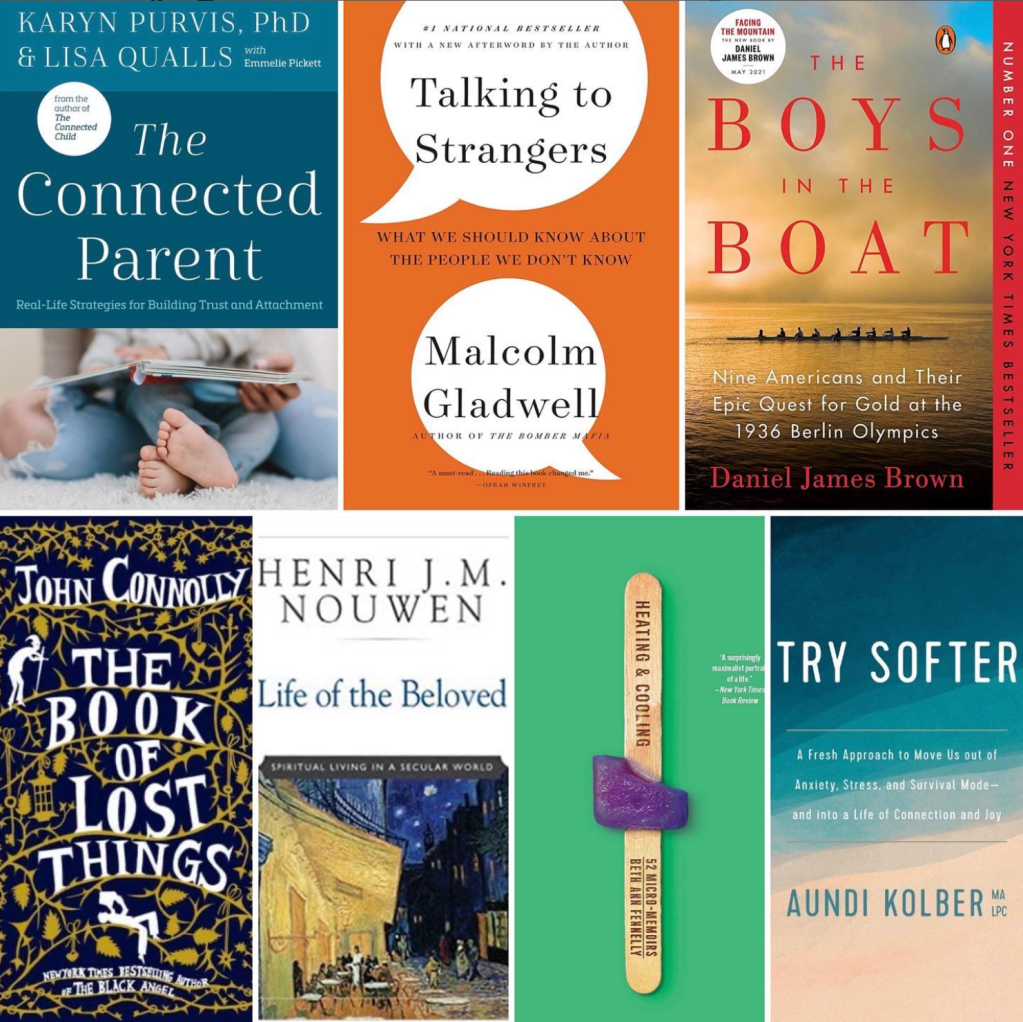
The Connected Parent by Karyn Purvis PhD and Lisa Qualls — This is the follow-up book to The Connected Child, also by Karyn Purvis, released about 13 years before, which had become the basic handbook for adoptive parents. This new update has much of the information as the first book, but with the added benefit being co-written by a mom who has lived through years of the experience of raising challenging adopted children. It’s a book that I read about twice a year and always come back to when I’m at my wit’s end and need encouragement. An absolute must-read for foster and adoptive parents.

Talking to Strangers by Malcolm Gladwell — I totally judged this book by its cover, and thought it was about something along the lines of “how to talk to people you don’t have much in common with.” It turned out to be much more fascinating than that, and in the months since I’ve read it has actually been valuable. Gladwell explores concepts like truth default, why we believe liars, and how knowing more about someone doesn’t mean you are a good judge of character. In fact, it’s more likely that the more you know someone, the less reliably you’re able to judge their character. Here’s a quote: “You believe someone not because you have no doubts about them. Belief is not the absence of doubt. You believe someone because you don’t have enough doubts about them.” I listened to this on audiobook and it was a great listening experience.

The Boys in the Boat by Daniel James Brown — From my favorite genre of narrative nonfiction, this book is about the US Olympic Rowing team that went to the 1936 Olympics. It was a fascinating look at the courage it takes to be a champion rower, and also the politics of WWI and WWII.

The Life of the Beloved by Henri Nouwen — I saw this recommended by a favorite author, Lore Wilbert. This book is a result of Nouwen trying to share God’s love and grace to a friend who didn’t believe in God. It’s full of reminders and encouragement for those of us who do believe.

Heating & Cooling by Beth Ann Fennelly — A book of “52 micro-memoirs”. It was a funny and very enjoyable read.

Try Softer by Aundi Kolber — This was recommended by two of my favorite people- Lisa Qualls (author of The Connected Parent) and Kendra Adachi, author of The Lazy Genius WayI listened to it on Audible, and it was like having a therapist in my ear. I think everyone needs to read Try Softer. It’s basically a how-to for being gentle with yourself, especially if you have trauma in your background. A Christian, trauma-informed therapist is an amazing resource, but if that isn’t possible, this book is the next best thing. I will probably be revisiting it annually.

March Books.

March Books

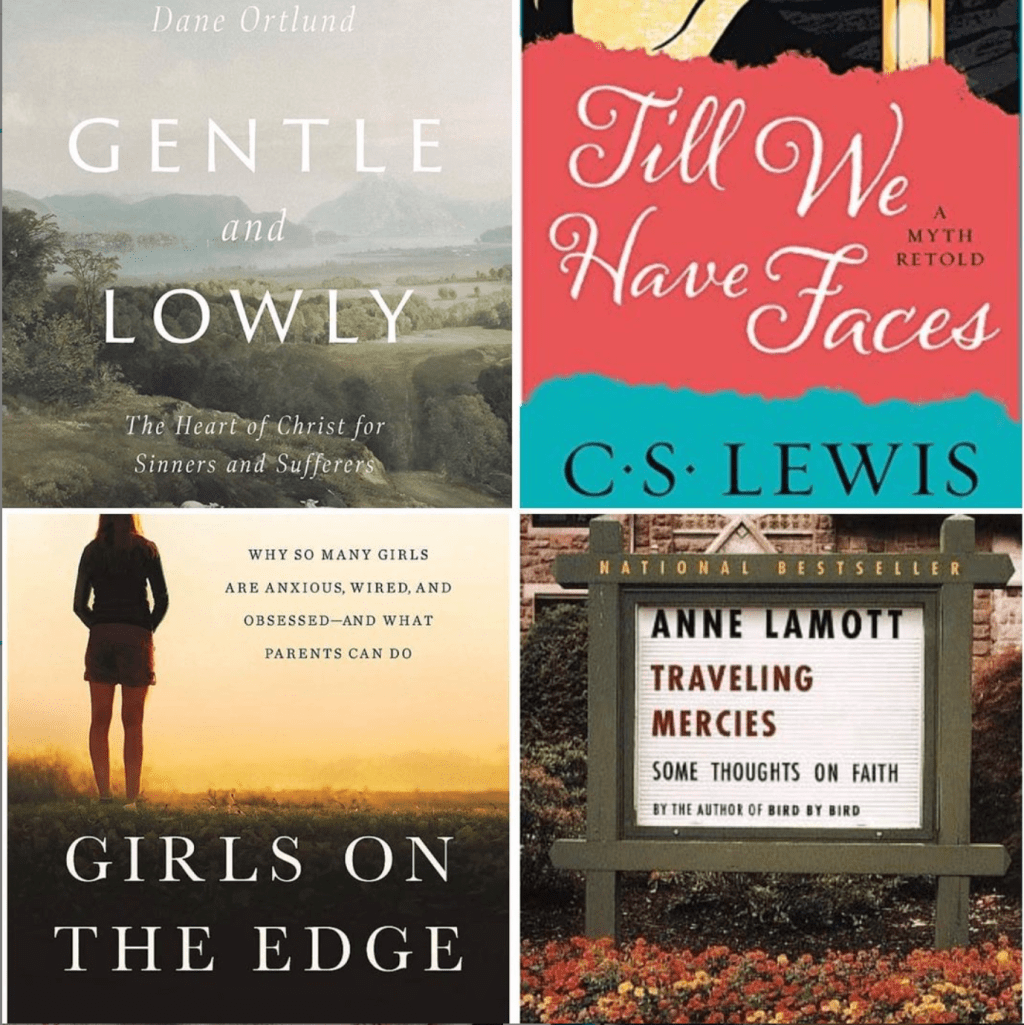
Gentle and Lowly by Dale Ortlund — Probably one of my favorite parenting books. It’s not about parenting at all, but it has helped me tremendously as a parent. It’s taught me how to be a more patient parent to my children by showing in detail throughout the Bible how much patienct, mercy, and grace God has with His children. It’s definitely a book I will be rereading annually.

Till We Have Faces by C.S. Lewis — Based on the myth of Cupid and Psyche, this is a book that was hard to push through, but it was worth it. C.S. Lewis shares his philosophy on envy, betrayal, and love. I love his books because they are so rich with ideas that often make me just stop mid-page and think about what I just read. One of my favorite quotes I’ve read in a long time came from this book, about longing for death not out of despair, but out of joy, a hope that somewhere a better place than this one exists and we will go there someday.

Traveling Mercies by Anne Lamott — I love Anne Lamott so much for her honest writing. She doesn’t pretend to have everything together, but simply invites her readers into her messy life, and writes in a way that makes you feel less weird about your own messy life. Traveling Mercies was all about her journey to faith in Christ and her thoughts on hypocrisy in faith.

Girls on the Edge by Leonard Sax — The subtitle of this book is Why So Many Girls Are Anxious, Wired, and Obsessed – and What Parents Can Do. This book was good at pointing out the areas that we as a culture our failing our daughters: sexualization, chemical exposure, too much technology/social media – and what we can do as parents to protect them from growing up too fast, both literally and figuratively (enforce modesty, change their diet, limit technology). I always love Sax’s parenting books because he encourages parents to apply their authority for the well-being of our kids. To hesitate our authority is to put our children at risk.

February Books.

I always have at least three books going at a time, but usually as many five or six. I read a few minutes from each one every day, and by the end of the month it really adds up! This month I cut back my internet time and (shocker) had so much extra time to read. I even splurged on a kindle/audible combo for one book so I could switch back and forth between them as time allowed. 

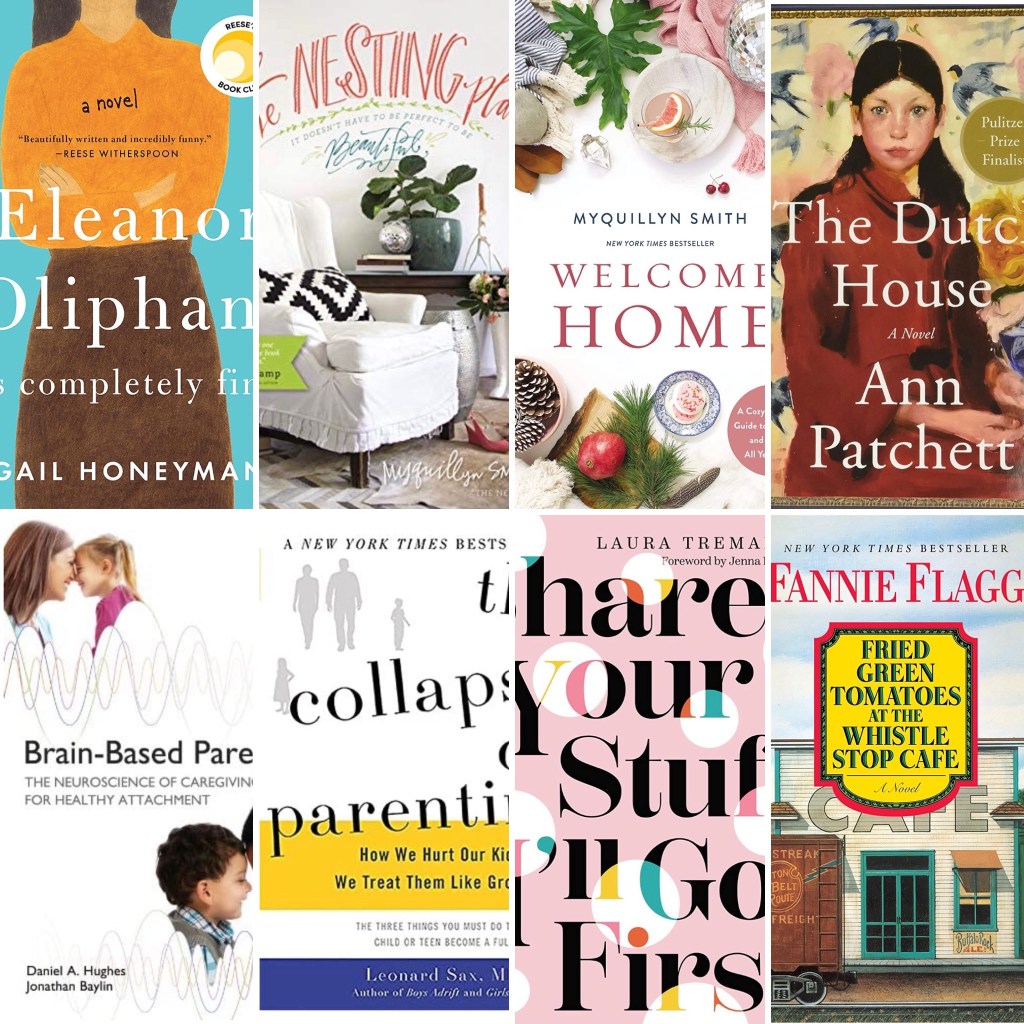
Eleanor Oliphant is Completely Fine – by Gail Honeyman — I actually thought this was another book when I started reading it. Then I thought I knew where the story was going. But it ended up being a completely different story than I thought it was going to be at the beginning. It’s about a woman who slowly unravels the trauma of her childhood, makes peace with her past, and grows into a mature friendship. 

The Nesting Placeby Myquillyn Smith — I’m in the middle of packing, purging, and taking the opportunity of a new nest to make some fresh changes. So I’m on the lookout for ideas for creating cozy, comfortable space in our new home. The author has lived in 14 homes in 18 years, so she knows about creating a home out of a house. Biggest takeaways: Limitations are a good thing. Things like a small budget, or a weird house layout, or a rental home that you can’t change are good things. Having too many options can be paralyzing. Every home has potential, if you just embrace it. 

Welcome Home – by Myquillyn Smith — More about making a home stylish and cozy, but more focused on minimalism and using each season to inspire style. 

The Dutch House – by Ann Patchett — A story about a brother and sister and the huge, elegant house they grew up in until their father died and their stepmother kicked them out. Together they navigate adulthood, relationships, and ultimately forgiving their estranged mother. I listened to this on Audible (read by Tom Hanks) and enjoyed it. There isn’t much of a plot, so it’s one of those books where you listen to people’s thoughts about life. I happen to love this kind of book, but I know it drives some people crazy.

The Collapse of Parenting – by Dr. Leonard Sax – My favorite read of the month. Key points: 1. Teach kids humility. They are not the center of the family (some of my people need this reminder!) 2. Conscientiousness and self control are the best predictors of adult success 3. Enforce good habits, don’t wait for your kids to want to do the right thing. “We are what we repeatedly do. Excellence then, is not an act, but a habit.” This book was a much needed course correction for our parenting. 

Brain-Based Parenting: The Neuroscience of Caregiving for Healthy Attachment – by Daniel A. Hughes — High recommended by adoption specialists. This one took me all month to read because of how dense it was, but it was well worth it. It helped me understand a lot about attachment dynamics and had a lot of helpful advice for dealing with challenging behaviors. 

Share Your Stuff, I’ll Go First – by Laura Tremaine — A guide to being a more open friend and inviting others’ stories into your life. I’m super introverted and usually think people don’t care so much about what’s going on in my life, but according to Laura, when you ‘share your stuff’ it invites others to share their stuff, and deeper friendships are the result. Thanks to the pandemic I haven’t had the chance to test out this theory yet, so we shall see. 

Fried Green Tomatoes at the Whistle Stop Cafe – by Fannie Flagg — Just like the movie but so much better. 

Sisters.

My current dilemma: how to teach four little girls how to be good sisters when I have no idea what I’m doing?

I was an only child growing up. It was a very lonely, quiet childhood. I remember wishing for a sister, but knowing that with my single mom, it wasn’t going to happen. So, the sister thing is a big mystery to me. I’ve noticed (admittedly with some envy) adult sisters together and their inside jokes, shared history, language known only to each other.

I’ve read about sisters in books: the relationships between the four sisters in Little Women are both fascinating and intimidating. The rivalry between Jo and Amy, the tenderness that Meg has for her younger sisters, the sweetness between Jo and Beth. I simultaneously want to be one of those sisters, and also glad I’m not their mother. 

Now I have two sons and four daughters. My sons seem to know how to be brothers without anyone telling them: they wrestle and burp and play video games together. They annoy each other, but quickly recover.

But these girls of mine have a lot of feelings and words — so many words! — and sisterhood seems a bit more complicated. (It involves a lot less burping, that’s for sure.)

But how do I make good sisters? I’ve asked a few friends who themselves are sisters and are also raising a few daughters, and they seem confused by the question, like the task was so intuitive it wasn’t even something they thought about.

After a frustrating scene one day when one daughter was complaining that another one was wearing her shirt, I decided to just start winging it right then and there. I made up a rule: “Sisters share clothes”. (I know this because I’ve seen it done in shows, so I’m assuming it’s something sisters do.) It worked. My little girls acted as though this new information was valid, and so they started sharing clothes. Just like that. It seemed way too easy.

I started looking around to see what other rules I could come up with that teach these little girls how to be sisters. “Sisters say kind things to each other” after one child was purposely annoying her sister by calling her “Katie Watie” over and over until she screamed. This is a phrase I do have to repeat a lot, but when I do it tends to help the sister in question change their actions.

A question I ask a lot is “Are you being a kind sister right now?” I could easily leave out the ‘sister’ part and just ask “Are you being kind?”, but I think that stressing the sister part of the equation is very important.

They play a game where they pretend they are sisters. The 4 year old says “Now, let’s pretend that we’re sisters, and Lucy put me in jail, and you come and save me…” The oldest sister will be the jailer and lock another sister in the slammer, and the now-incarcerated sister will call out until the Savior Sister comes to the rescue. The fact that they actually are sisters and then play pretend sister games is beyond adorable to me. 

Another new rule: Sisters serve each other. My oldest daughter (almost 8) loves making herself tea. I suggested “See if your sisters want some too”. Of course they did, and now Sister Tea Time is a near-daily event that involves a lot of sugar and spilled milk, but also sweet memories. 

I feel incredibly blessed to be able to watch the sisterhood relationship unfold between my four daughters. I am so grateful that they have each other. I know there will be fights and disagreements and their relationship won’t always be rosy. But when I picture my four daughters as adults, I see four women who are loving and loyal to each other. I pray that they end up something like the March sisters: sacrificing for each other, loving and serving each other, and always forgiving. And I know I’ll be reading Little Women a few more times over the years to get some tips from Marmee.

Baby Turns One.

Our youngest child turned one yesterday. She’s not really ours yet, though. She is our foster baby, currently waiting in a legal limbo, for courts to open up again so she can be legally freed from her birth parents, and then the county’s plan is for us to adopt her.

It is very strange to be in this place of being joyful over a child’s milestone, and yet realize that she’s not technically mine. We’re not yet guaranteed a future together. And so we take each day, each milestone as its own special gift. I try to hold off on thinking about the future too much.

Baby E came to our home when she was just a few days old. I picked her up at a hospital in our nearby city, a hospital well-known for its substance-abuse births. There was some discharge paperwork holdup, so we ended up having a few hours to ourselves to get to know each other.

Looking back, I am thankful for that time of waiting together. I snuggled her newborn little body. I fed her a bottle. Changed her tiny diaper. Snuggled some more. She was so peaceful, content to just look towards the window or into my face. In many ways she is the same baby a year later… happy and content. She doesn’t realize the legal events going on around her.

Caring for children in foster care and adoption is a reminder that even my birth and adopted children aren’t really mine. They are with me only for today, and I’m not guaranteed a future with any of them. They could be stricken with cancer next week, or get hit by a car (both these are real possibilities, that have happened moms in my circle of aquaintaces).

My God-given task is to love them today, and teach them about their Maker. Lord, help me to really be with them all today, to really see them and hear them, and point them towards their God who loves them so much more than I ever can.

Life as an Education.

I have never let my schooling interfere with my education.” – Mark Twain

My oldest son is 13. He just finished up 8th grade last week and he’s already started on his freshman year through online high school. He’s eager for the next exciting chapter of life.

He has been homeschooled exclusively since … well? I want to say since kindergarten, but really his education began much earlier than that. It has its roots in the toddler who dug holes and made rivers in the sandbox. In the boy who stacked bricks leftover from a yard project into tall structures. We read lots of books, watched bugs, and made pancakes and bread together.

When school did officially start in kindergarten at age 6, it was an event hardly worth noticing. We would do some counting work, practice writing letters, and maybe a craft once a week. That lasted about 30 minutes a day, which even then was pushing his 6-yr old attention span. And to be honest, there were many days we didn’t even do this. Many days were simply spent outside. Children don’t necessarily have to ‘do’ school every single day to leap forward in their learning. The hard thing is getting our busywork out of the way so they can do the real learning.

This ‘method’ was born a little bit out of a philosophy of education that says that children should have short, focused lessons when they are very young and plenty of time to play. But it was also born in large part because he was a very active, emotional, hyper kid. In other words, a normal boy.  

As his attention span, his abilities, and his curiosity grew, our lessons grew a little longer, but still not by much. It wasn’t until about 5th grade that his assignments ramped up slowly. I gave him some say in what books he read for science and history, and made sure he wrote a paragraph every day summarizing something he’d read that day. By this time “school” took him a solid 2.5 hours, including music practice, math, reading, and handwriting. 

It was around this time that we took an entire year off. It was the year our foster daughter, then one-and-a-half, spent a month in the intensive care unit at Stanford Children’s Hospital as a result of an E. Coli infection. Then she got diabetes and we all needed to learn how to care for her. Then I found out I was pregnant and had about four months of near-constant exhaustion and intense mood swings.

That year our school was beach days, audiobooks, and nature walks. We did nearly nothing in the way of “real school”. And yet, when I felt well enough to resume a bit of structure and we resumed our lessons, I found that he hadn’t missed anything at all. He ‘caught up’ quickly in math (in quotes because, caught up to whom?). And when he took his first standardized test (the Iowa Assessment) just a year ago, he tested above grade level in nearly all subjects.

The middle school years were preparation for high school: He had even more say in the books he read. (One of his science books was What Einstein Told His Cook: Kitchen Science Explained, perfect for a young physics lover who enjoys cooking.) I think because I listened to his interests, he was more willing to read the books I’d place on his stack. He learned how to budget his time. Look online for answers to math questions when they weren’t readily apparent. Persevere through a very difficult math concept. School was challenging, but he was mature enough to accept the challenge. Schoolwork took him about 3-4 hours a day.

As I reflect back on these nine years of homeschooling my son, I don’t wish we did more. In fact, I wish I’d pushed a little less and had a little more patience. I wish I could have dropped the guilt of “not doing enough”, because now I see that we did just enough. I feel grateful to have had the opportunity to watch the process of this squirrelly little boy of mine flourish into a young man ready to take charge of his own education.

If your kids are just wrapping up their school year and you’re considering what the world will look like as they head (maybe) back to school in August, consider homeschooling. It’s a suprisingly wonderful experience. It’s difficult at times, but so full of joy as you and your child grow and learn together.

Some books to inspire: 

The Call of the Wild and Free: Reclaiming Wonder in Your Child’s Education by Ainsley Arment

For the Children’s Sake by Susan Schaeffer MacAulay

The Unhurried Homeschooler by Durenda Wilson

Screen-Free Week.

This past week was a week of No’s – no sugar for us parents, and no screens for the kids. Both were impulsive decisions late Sunday afternoon, and both were made as a result of overindulgence these past few months. 

Going screen-free was painful the first day or so, but the kids figured out new things to do with their time. Instead of a show first thing in the morning, they went outside and checked on their garden and danced in the rain. Instead of asking for a show during quiet time (a bad habit I’ve slowly let them slip into), they used wooden blocks to make stalls for their horses and set up a “bookstore” to be patronized by siblings after quiet time.

There were a few rare exceptions to the screen-free week, like when Katie had a 3-hr long assessment via Zoom on a rainy day and older siblings’ availability to babysit was limited. Even then, the kids still spent a good part of the time outside. 

What have I learned as a parent during this week? Not to underestimate the creativity and resourcefulness of children when given plenty of time to be bored. Most often it’s my lack of patience to deal with a little bit of front-end whining that leads me to turn on the TV, when what’s best for my children is to give them the gift of free time.