How to be friends with a neurotypical 

**Disclaimer: This is meant to be satire and is not meant for instruction or to give offense. As a woman on the autism spectrum who feels quite normal, it can be challenging navigating a world run by those who are supposed to be “normal” but who can also be difficult to get along with, despite being “neurotypical.” 

Most of us like to think our society has come a long way since the old days of avoiding people based on their differences (think: kids on the playground chanting Four eyes! Four eyes!). These days there is a big movement toward being inclusive. There are school playgrounds with “buddy benches” where a kid feeling excluded can sit and, ideally, someone will befriend them. Now mainstream TV shows feature characters with cognitive differences. These are all great steps toward inclusion.  

On a day-to-day basis, it may initially seem awkward to include those different than we are in our lives. Friendship is hard enough as it is, but when you add in differences, it compounds the challenge. So here are three ways I’ve found to help navigate building friendships with those on the neurotypical spectrum(NTs): 

1. Communication differences This is a huge category with many differences, so I’ll cover just the basics here. Understanding their communication may take a little while, but it’s worth the effort. 

It’s important to realize that most NTs have difficulty saying what they mean. When they say, “Talk to you later,” they don’t literally mean they plan to call you again later that day. Or when they say the bank is next to the movie theater, they probably mean it’s nearby the movie theater or perhaps somewhere in the general vicinity. You’ll have to learn the NT’s most-used phrases and their translations, which can vary from person to person, adding an extra layer of challenge.

Making eye contact is a large part of NT communication. Generally, they place a high value on looking them in the eyes while you talk to each other. They believe it shows respect and interest; conversely, not looking them in the eye while you talk shows disrespect and disinterest. There are a few options here for bridging the gap: 1. You can ignore their social customs and look wherever is comfortable for you. 2. Some find it helpful to stare at a fixed point in the middle of their face, giving the illusion of eye contact and therefore making them more comfortable. 

Another part of the category is NTs’ difficulty with direct communication. They tend to rely on hinting and indirect language. So if your girlfriend wants you to come by her workplace during her break, she may say something like, “Hey, if you’re not busy later, you could come by my work to say hi.” Or if you’re at an event together, they’ll say, “Hey, do you think we should go now?” and you’re supposed to infer they mean they want to go now. Or they’ll mention, “I’m getting cold,” instead of simply asking you to close the window. It takes time and practice to discover the hidden meaning of what NTs are trying to say. 

The flip side of this is that NTs generally have difficulty receiving direct communication. They often view it as confrontational and may get offended easily. You need to ensure your communication includes filler words and phrases.

2. Sense of time — Many NTs have organization deficits with time. Like the above example about communication, they may say to meet them somewhere at 7:00, but they likely don’t mean exactly at 7:00. It is acceptable to arrive up 15 minutes after the agreed-upon time. In fact, many NTs are unnerved if you are always exactly on time—to make them more comfortable, it’s important to vary your arrival time. 

Another part of this is their sense of flexibility when it comes to making plans. If you make plans with an NT, it’s a good idea to have a backup plan in case the person is very late or the original plan falls through. I meet a friend to walk early mornings once a week, and I have a fifty percent chance that she will either forget or be very late. It’s easier for me if I have the correct expectation.

3. Emotions — People on the neurotypical spectrum may struggle with emotion; strong emotions seem to be bubbling just under the surface. What seems like a minor offense can set them off. (This is also tied to communication differences since they seem to go together). 

One day I was helping a friend out with a project through WhatsApp voice messages. I told her I would take care of a certain area of the project, and she said that sounded good. The next day I found out that she was very upset and felt like I was taking the project away from her. I was very confused. After several voice messages, I finally I realized that I was being direct, and she was being indirect with me, and our meanings were getting mixed up in the process. 

Staying calm and offering a listening ear is important when they express big emotions. You can say reassuring phrases like, “I’m sorry this is so hard for you” or “I hear what you’re saying.” You may not understand exactly what they are going through, but you give them your presence and make them feel seen.

Conclusion: Unfortunately, no therapies exist for those on the neurotypical spectrum to gain better social skills or navigate friendships. It’s up to us to have grace with them. Give them the benefit of the doubt when it seems like they are being rude. After all, we appreciate when others have grace with us. And if you’re feeling especially adventurous, you may be able to take an NT under your wing and show them a better way to communicate and build friendships. 

My Tween Has Mental Disabilities — How I’m Learning to Manage Puberty and Periods

Note: This is a version of something I originally wrote for my husband, who doesn’t know much about periods, so for this article, I assume my audience is a mix of men and women.

My daughter Abbie (not her real name) is ten years old, with chopped brown hair and freckles sprinkled across her face. She has a genetic condition like Down’s Syndrome, except hers is a duplication of the 8th chromosome instead of the 21st. She was diagnosed with type 1 diabetes around age two and a developmental delay later that same year. Just a few months ago, she was diagnosed with autism. She’s a 6-year-old in a 10-year-old’s body. 

It was Abbie’s autism evaluator who brought the topic of periods and disability to my attention when she reviewed Abbie’s diagnosis with me. We were talking about how Abbie would likely need lifelong care because of her delays and medical needs. She brought up the topic of periods and said, “You know, when she starts puberty, you can make her periods go away so you don’t have to deal with all that. Just put her on birth control. A simple shot will do it.” I had no idea that was a thing, and it didn’t sound so simple. So I decided to read all I could about it.

It turns out it’s not so simple. After reading several journal articles, I realized that this is a vast and complicated subject.

The World of Periods and Puberty – Emotional and Physiological Changes

The average girl will have her first period (menarche) between 11-13. This milestone is no different for girls with developmental disabilities. All girls, regardless of disabilities, will experience the cramps and mood swings that come with having a period. The first 6-12 months of menstrual cycles may be irregular and spotty. Cycles generally regulate after a year or so.

The onset of a girl’s period indicates that growth is slowing down. Bones are just about done growing, and major bones solidify and fuse at the joints. A girl is just a few years away from her final height.

All girls need to be aware of puberty changes before they happen, so parents should frequently talk with their daughters about changes to expect, at minimum, around age 10 for typical children. For kids with cognitive disabilities, it’s probably a good idea to start sooner since it often takes time and repetition until complex concepts (like puberty) sink in.

Adolescents with disabilities need period- and puberty education adapted to their learning styles and needs. It’s easy to think that people with mentally disabilities are asexual or unable to understand the concepts involved with puberty changes. But they do have a spectrum of sexual feelings. Treating them as if they don’t only leads to problems later. As with most parenting issues, having open communication goes a long way in making all kids feel comfortable and understood. 

Reasons & Methods to Suppress Periods

Parents and caregivers can have a lot of anxiety around the idea of their child with disabilities dealing with her period. They may be concerned with the practical side of their child changing pads in public restrooms. For girls with disabilities that may still need toileting help, the idea of dealing with a period can seem overwhelming to both the caregiver and the child. Suppressing periods can be an option to simplify life.

Many birth control methods have the side effect of suppressing periods. The most effective is the shot (Depo-Provera). Unfortunately, ​research suggests that Depo-Provera causes bone mineral density loss. This loss might be especially concerning in teens who haven’t reached their peak bone mass. It’s unlikely that this loss is reversible.

There are two birth control methods that are effective at suppressing periods and have the least side effects. One is birth control pills (continuous combined oral contraceptives). There are several different options and brands to choose from. With continuous use, up to 88% of women reported their cycle stopping after one year. The downside of this method is that a pill needs to be taken at the same time every day for effectiveness. But this may not be a problem if a parent or caregiver helps the child remember to take their pill every day.

The other method is a birth control patch (transdermal combination contraceptive), which has similar effectiveness as the pill, but has the added benefit of only needing to be applied once weekly. The patch can go on the upper arms, belly, buttocks, or even the back between the shoulder blades to prevent the child from picking at it. With both methods, adding a regimen of NSAIDs (Motrin, Advil, etc.) during the week of menstruation decreases discomfort and bleeding by reducing prostaglandin production, the hormone responsible for period cramping.

Sexual Abuse – Rates and How to Prevent 

One of the startling things I came across when looking at the literature on this topic is the link between independence in caring for oneself and sexual assault. 

Girls with cognitive disabilities have a huge risk of sexual assault. The US Department of Justice reports that 70-80% of women with developmental disabilities will be sexually assaulted in their lifetime. Less than half of them will seek treatment. Reasons for this increased risk include: inappropriate social skills, poor judgment, inability to seek help or report abuse, and lack of strategies to defend themselves against abuse. Out of fear, caregivers tend to shelter their child with disabilities by physically keeping them away from others and keeping them in the dark about sexual topics. Unfortunately, this can have the opposite effect and often doesn’t actually keep them safe. Furthermore, one author notes that “praise for cooperation and following commands makes a [child] vulnerable” to harm from non-caregivers.

Self-esteem is one deterrent to sexual abuse. Girls who are confident in their abilities are less likely to be taken advantage of. Parents should help their children with disabilities become independent and resist the urge to infantilize them. Practically, girls who realize they can care for themselves (as much as possible) need less help from others. This equals fewer situations with non-caregivers where sexual assault is more likely. 

One author notes: “Abuse prevention should include “NO-GO-TELL” so that youth understand to clearly say NO, to physically GO away when able, and ultimately to TELL a trusted adult.” 

Conclusion

When I first started looking into this topic, I honestly thought I was being a bit silly for taking it so seriously. I wondered if we should take the expert’s suggestion and get Abbie a shot to make her periods go away when the time comes. After all, they know more than me, right? I am glad I did the research. This topic is so much bigger than period care. It includes even bigger topics like bodily autonomy, self-esteem, sexual abuse, medical care, and what Abbie’s adulthood will look like. I have only scratched the surface. 

I’m inspired to work with Abbie more intentionally on bodily autonomy. This includes things like bathing, diabetes care, dressing, and even food prep. In the past few months, she has expressed a desire to bathe/shower herself. I’m usually in a rush, so I bathe and wash her hair myself. But in light of this new information, I have been taking more time to teach her to wash her own body and her hair. It’s not perfect, but she is making progress. And she feels capable and good about herself. Abbie needs to learn and to feel that she is in charge of her own body. This will help protect her immensely in the future.

This also goes with medical care. We should listen to Abbie when she tells us where she wants her diabetes pump or monitor to go. In the past, I would ignore her wishes and do whatever. But it’s important that Abbie realizes she has a say in where her medical devices go on her body (within reason, of course). 

We need to treat Abbie as a normal girl entering puberty. I bought several books about puberty, periods, and how babies are made, and my project will be reading them with her. I plan to have a special tea time once or twice a week where all the girls read the books with me. The more I read about girls and puberty, the more I realize that it should be a normal thing talked about from a young age. Most of the books go over the idea of bodily autonomy and cover the  “NO-GO-TELL” strategy to help girls realize that if someone touches them in a private area, it is NOT okay and is something they need to tell a trusted adult about immediately.

My head is dizzy with the implications of teaching Abbie more independence. For instance, her goal is to attend a sleep-away diabetes camp next year. Do we let her do that? We would have a long list of things to teach Abbie to do independently before going, such as bathing completely independently, finding out from camp counselors this year what kind of independence she is expected to have (for instance, do typical 11-year-olds keep an eye on their own blood sugar?) 

In the past, all this has seemed so overwhelming. I didn’t see any desire in Abbie to learn to take care of herself, and I didn’t see the point in even trying to teach her since it seemed likely she would live with us for the rest of her life. I resigned myself that we would have an adult 10-year-old forever. But after reading all these articles, I have hope that Abbie can reach a level of independence. And it’s vital that we help her as much as possible.

Resources

Books about puberty and periods abound, but it can be tricky finding titles written for kids with intellectual disabilities. Here are some that I have found helpful for Abbie:

  • The Girls’ Guide to Growing Up: Choices & Changes in the Tween Years by Terri Couwenhoven— If you only get one book about puberty and period care, make it this one. It’s written at 1st-2nd grade reading level and is perfect for reading through together. There are tasteful illustrations and step-by-step photos like the occupational therapy photo guides Abbie is used to.
  • The Care and Keeping of You 1: The Body Book for Younger Girls by Valorie Schaefer— This is written at a 3rd-4th grade reading level and has engaging illustrations. 
  • Yes! No!: A First Conversation About Consent by Megan Madison, Jessica Ralli, & Isabel Roxas— a wonderful starting place for teaching kids about consent for touches, hugs, tickles, all of it. I love that the authors point out that it’s okay if others’ feelings are hurt because you’re uncomfortable with giving a hug. 
  • Own Your Period by Chella Quint — This is written for grades 4+, so a bit above my daughter’s level, but it was worth getting for the great illustrations and pro-girl attitude. Parents and caregivers can choose to read excerpts or just look at pictures. 
  • It’s So Amazing! By Robie H. Harris and Michael Emberley — I’ve been using this as a reference rather than reading straight through it. It’s written at a 2nd grade level, so it’s perfect for my daughter’s level.

We Need to Talk About How Hard Summers Are

For most, the end of the school year and the beginning of summer break means freedom: slow mornings, popsicles, slip-n-slides, and late bedtimes.

But for parents (like me) of kids with special needs, it also means the end of the predictability our kids rely on to regulate. They miss the structure and rhythm of the school day. And let’s face it, we parents miss the structure of the school day. It can be hard for us to replicate the same routine our children depend on nine months out of the year. During the summer, our days are a marathon that begins at sunup and doesn’t end until sundown. 

I have six kids in total: two are teenagers with jobs, and the other four are 11 and under. Three of those kids have special needs, and the caboose is a cute but mischievous toddler.

Most days, I count down the hours and then minutes until naptime and then bedtime. I drag myself over the finish line at the end of the day, only to collapse in a tired bump on the couch, no brain left to do anything except watch a mindless Netflix show, then pass out for the night. Then do it again the next day. 

My older kids’ summers were dreamy: hours spent playing in the backyard, splashing in the kiddie pool, and building cool structures out of stuff lying around. They rode their bikes to friends’ houses and the town pool when they were older. 

Internet articles tell us that our kids need plenty of unstructured playtime during the summer. They tell us boredom is good for them. They tell us our kids need a summer from the 1980s: tech-free and carefree. 

That may be great for some kids, but my kids with special needs don’t have the skills necessary for such a summer. My cognitively delayed child likely won’t ever be able to ride her bike around town. And while my child with poor executive functioning is technically old enough to be on her own, she can’t make good decisions. They all need close supervision, so I am always on. 

This summer, I’ve gotten better at building in pockets of time for myself. I hired a high schooler to come once a week to hang out with the kids for a few hours so I can sit at a coffee shop alone with my laptop and a book. And I’ve gotten better at sharing my summer struggle with others. When I meet up with friends at the park, instead of painting a happy picture of our days, I am more honest about how hard it is. More often than not, they know exactly what I’m talking about because they’re in the same boat. 

The feeling of that first drop-off is what’s getting me through the summer. That blissful feeling of returning to my quiet house, knowing that all my kids are safe at school, happy, and cared for by teachers they love. The feeling of running errands without a) bringing a field trip with me or b) having to negotiate with my husband so I can go alone. 

If you have a friend with special needs kids, reach out to them. Ask them how you can partner with them and help them this summer. It might be as simple as bringing them a meal so they can hang out with their kids instead of multi-tasking kids and dinner. Or bring your kids over with some sidewalk chalk and a box of popsicles to help distract your friends’ kids and help pass the long summer afternoon. 

If you are the parent of a special needs child, ask for help. Don’t pretend everything is going well. Tell someone how you’re really doing. If you have the means, find a babysitter and schedule some alone time for yourself. If you can’t afford a babysitter, try asking a friend for a babysitting swap. At the very least, schedule downtime every day. At our house, 1:00-2:30 is quiet time, where the toddler takes a nap and the older kids (all not yet readers) sit in separate rooms and listen to an audiobook while looking at books or drawing. It’s a non-negotiable time every day. I use that time to read a book and take a power nap to recharge for the long afternoon ahead. 

Most of all, give yourself grace. I know you’re a great parent and you’re doing your best. Summer is just a season, and the kids will be back in school before you know it.

God Answered My Prayer for Patience—Ten Years Later

Have you ever prayed for something for so long that you didn’t even realize God had already answered your prayer? And all you had to do was open your eyes and see that the answer was right there in front of you?

I’m sitting around the long wooden table in our dining room, celebrating my 40th birthday with my favorite people: my husband and six kids. We’re tucking into our slices of ice cream cake beneath a black and white banner that simply states, “It Is Your Birthday” (which fans of The Office will appreciate). I’ve opened my gifts, read the cards, and now it’s that awkward time when everyone takes turns saying what they like about the birthday person (me). 

My 6-year-old starts with, “I like it when mom plays games with me.” 

My 10-year-old says, “I love that Mom is patient with me. She doesn’t get all stressed and excited when I mess up.” 

My 15-year-old says, “I like that she puts up with me.” [He’s referring to an ongoing friendly feud in our family where I find his noises and jokes amusing, but my husband is sometimes annoyed by them.] 

My 16-year-old son says he appreciates that I’ve always carefully considered what I say yes or no to, saying it would be so much easier for me to say no to more… and that he realizes it’s harder to say yes. 

Yet—I can’t take any credit for this praise because it hasn’t always been this way. Ten years ago, my sons were five and six, and they were a serious handful. One was a fountain of constant questions, and the other liked to climb to the top of tall things and jump off. Every day was an adventure raising those boys.

In addition, I also had a toddler and a new foster baby. I’d had a miscarriage the year before, and without knowing it at the time, I was dealing with postpartum depression. Most days, I barely clawed my way to the day’s finish line. I tried so hard to respond patiently to my small kids, but I often failed. 

I thought my lack of patience was a spiritual or character issue. I spent my morning prayer time begging God to make me a more patient mother and to enjoy my kids. But each day, I continued to fail. And then, each morning, I would wake up and pray for patience again and fail again—the motherhood version of Groundhog Day.

Without me even realizing it, God gave me patience. He didn’t sprinkle it down from heaven. He didn’t flip a switch. He gave me thousands of opportunities to practice patience. 

These days, when a child spills a cup of water at dinner time—the same child that spills their cup nearly every meal—God reminds me that I also mess up, and when I do, I appreciate when someone helps me instead of criticizing me. When my daughter with ADHD forgets to do her chores every single morning for years, I can gently remind her again every morning. When my toddler draws on the wall with a crayon, I can teach her how to wipe it off rather than get angry.

And the bigger things—like when our foster baby cried incessantly for the first year she was with us and would only stop when I carried her. When we fostered another baby and the adoption process took two years longer than we expected. When our daughter landed in the hospital, we didn’t know what the future looked like with her, and we were forced to take one day at a time. When I was unexpectedly pregnant and was forced to slow down. So many lessons over the years. 

The thing about having a large family is that the kids don’t take turns with their issues. Often, their problems arrive all at once, like seagulls swarming a bit of food. Leaning into the chaos and learning my limits of control were the things God used to teach me patience.

One of my favorite Bible verses is “My grace is sufficient for you, for my power is made perfect in weakness” (2 Cor. 12:9 NIV). What a humbling reminder that it is when we let go of control that we gain God’s peace and strength. 

If you are praying for something, keep going. Keep asking God for wisdom, or faith, or patience, or whatever it is you need. He delights in answering our prayers—and he may just answer your prayer while you’re busy living life.

How to Survive a Public Restroom with a Sensory Kid

Last fall, our family took a road trip from our home in North Idaho to visit family in California. Over two days of driving, we stopped in approximately 387 public restrooms. Okay, maybe not that many, but it felt like it. 

My 8-year-old daughter was adopted from foster care and was diagnosed with sensory processing disorder (SPD) when she was 3. SPD is when your brain has trouble processing information related to the senses. So sounds can be extra loud, lights extra bright, and smells overwhelming.

Your child may have a sensory processing disorder if you notice they clap their hands over their ears if they see an object that makes a loud sound— even if it’s not making a sound. My son would cover his ears whenever he saw a motorcycle or a hot rod car because he knows how loud they are when they start up. Some kids may purposely fall on the floor or crash into objects if they may have a need for more sensory input over their bodies. Some may hate to be swung on the playground swings, or conversely, some crave more and more swing time.

A public bathroom is a sensory nightmare for kids with SPD. Think about it: you walk in and there are toilets flushing, loud music, and often a fan. This is chaos for hypersensitive ears and a brain that has trouble processing all that input. Then you close the door on your stall, and the toilet automatically flushes before you’ve even done your business. You’re startled and shaken, and then you have to navigate using the toilet. Then it’s time to wash hands. If you can make the automatic faucet work, it often shoots water out like a jet, spraying mist all over. Then there’s the electric hand dryer that goes off if you even look at it. 

I’ve learned a few tips over the years while helping my daughter with SPD navigate the restroom experience: 

Try Noise-Canceling Headphones

Headphones can be a huge help for kids with a hard time with the loud and sudden noises that come with the public restroom experience. We’ve had a lot of success with the Snug brand—they fold up small enough to be tossed in a purse; better yet, pack your child their own sensory backpack with tools that’ll help them navigate the day. 

Cover The Toilet Sensor

I once read about a mom that carried post-it notes in her purse to put over the toilet sensor so it wouldn’t flush until her child was ready. I thought that was brilliant. I can’t fit another thing in my purse, so I use toilet paper to drape over the sensor. For those flat sensors on the wall, just moisten a tiny bit of TP and stick it on the sensor. Voilà! No more flushing. 

Consider Skipping Hand Washing

No, seriously, hear me out. By the time you’re ready to wash your kid’s hands, they are likely just done with the whole restroom experience and just want to escape. (There have been times my daughter literally runs out of the stall and out the restroom door screaming, so we definitely skipped hand washing). I keep sanitizer and wipes in my purse and the car when we just can’t deal with the sink experience. 

Divide and Conquer 

If possible, try to take the child into the restroom alone. If an older sibling or spouse can wait outside with the other kids, you can focus your attention on the sensory kid and the process may go a lot smoother. 

There is no cure for sensory processing disorder, but supporting the person who struggles with it can make their life a lot easier. Hopefully, these tips are helpful!

Education: What’s Best for Adoptees?

I was attending my third homeschool conference when I heard from a speaker who had adopted a daughter from China. His words piqued my interest because at the time I had one adopted daughter (who was a baby at the time) and two school-age boys. He believed that homeschooling was the very best thing for adopees because they have so much trauma and lost time with their new parents, and that it’s important to make up for that loss by having extra time at home together. That made sense to me. Even though I was already on board with homeschooling, I strengthened my resolve to see it through for the sake of my current and future adoptees. I was sure it was the best thing for them. Fast forward eight years and now all my (six) kids are in school. 

What changed? 

Well, life changed. When I started homeschooling, I had two fairly typical biological kids (one had ADHD, but it was manageable). Over the next few years, we added two infants to our family through adoptoin. Homeschooling certainly got busier, but it wasn’t anything I couldn’t handle. It wasn’t until our children that we adopted reached school-age and beyond that learning disabilities and trauma behaviors surfaced. I realized that homeschooling wasn’t working for our family anymore. My husband and I took a prayerful look at our family and options and decided to make a change.

It turns out that the question of “what is the best way to educate adopted kids?” (and let’s face it, any kids) is very complicated and can even change over time. Knowledge is power, so we’ll explore the pros and cons of the main three education options so you can make the best decision for your family.

Homeschooling Pros

Individualized Education: You can tailor the education to your child’s specific learning style. Kids who were adopted often have sensory and education needs that call for extra time in school or extra breaks. With homeschooling, you have the flexibility to take sensory breaks, ADHD breaks, etc. When my oldest child was a little guy, he would have to take frequent breaks to run around the house or jump on the trampoline before his little body and mind could focus on reading.

Flexibility: Because you only have a few students, homeschooling really doesn’t take that long. You have the ability to focus on just the one or few students you have, and your time isn’t taken up with classroom management like it would in a school setting. Especially for the younger years, core subjects of math, reading, and handwriting can take up as little as one hour a day—and you have the rest of the day for exploration, reading aloud, kitchen fun, art, or whatever areas you want to explore with your child(ren).

Also, you set your own school schedule. Some homeschool parents like to stick to the typical school schedule of educating August through May and taking the summer off, while others prefer to school year-round. When we homeschooled, we had Monday through Thursday as our core subject days, and Fridays were beach day or hike day. We did this for years and our kids learned so much from those Fridays of learning about creatures at the beach or on the trail. We also started the school year in July and would take a monthlong break in late September for a family vacation. We enjoyed empty parks, museums, and beaches while everyone else was in school!

Time For Extracurriculars: Do you have a kid that is passionate about piano, basketball, or robotic LEGOs? Homeschooling allows extra time for your child to dive into their passions. Learning often comes easier for our kids who were adopted when they can learn through things they are passionate about.

More Bonding Time: You have the luxury of plenty of time to spend with your child. You can snuggle up on the couch and read books, go on walks, bake together, go to the library, go to museums… the possibilities for togetherness and bonding are endless.

Homeschooling Cons

Routine: Adoptees usually need a set routine. It can be challenging to set and enforce a routine at home, especially if that’s not in your personality. 

A lot of Work: With the freedom of being in charge of your own schedule and curriculum also comes responsibility. It is all on you to research the curriculum, order it, and figure out how to use it. It’s up to you to figure out the best schedule for the day that fits everyone’s needs. It can be hard to feel like the entire burden of your child’s education rests on your shoulders—not to mention the stress of being with your children all day every day and finding it hard to get a break. It is manageable for some, but overwhelming for others.

https://604882cbeb362f1acaa60d84d2c592ff.safeframe.googlesyndication.com/safeframe/1-0-38/html/container.html

Missed Opportunities: When your child is homeschooled, they can miss out on opportunities for making friends, learning alongside peers, and learning from teachers with different teaching styles. It can be difficult to come up with the same extracurricular activities your child would get in school like sports, theater, and music lessons. When you homeschool, it’s all up to you to provide these opportunities.

More Stress (with personality/learning disability): The flip side to being with your child all day, is that, well, you’re with your child all day, every day. This can be overwhelming for some children and parents when there are personality conflicts present or even learning disabilities that make learning extra difficult for both student and teacher. 

Public School Pros 

Cost: It’s free!

Diversity: Depending on your child’s ethnicity and your community’s makeup, your child has a higher chance of being exposed to other cultures and ethnicities that may look more like them. This can help children who were adopted feel closer to their community and help with identity issues that may come up in their teen years.

Highly Structured: Your child will get the routine and structure they may need. The curriculum is provided by the teachers and performance is regulated to ensure that a state standard is being met. As a result, parents can depend on the quality of public education to be more consistent, reliable, and inclusive of each student and their needs.

Public School Cons

Resources: Some parents report that it can be difficult to get their children the individual attention or resources that they need. This can be especially true if your child needs special education resources. However, this seems to be highly dependent on individual school districts, so check with your community school district to find out more information. You can also ask fellow parents about their experience with the school district on your town’s Facebook or Nextdoor community page.

Lack of Flexibility: Your child will be expected to attend school even if they are having a rough day. It’s not easy taking time off for mental health days, therapy sessions, or even just family trips. 

Bullying: The NCES (National Center for Education Statistics) reports that roughly 20 percent, or one in five kids experience some form of bullying throughout their K-12 education. No parent wants their child to have to deal with the effects of bullying, so this is often a deal-breaker for those who want to shield their children from dealing with this.

Ratios: Some districts have larger class sizes which means your child may not get the individualized attention they need. But, according to USAFacts.org, most states’ class sizes are actually the smallest they’ve been in 30 years—today most states average 18-22 students per class, whereas 30 years ago they were closer to 30 per class. 

Private School Pros

Culture: Each private school has its own mission statement and culture. Some are focused on exploratory education, some are focused on high-achieving academics, and others focus on inclusion. You get to pick the culture you want your child to participate in.

Safe: Private schools are typically best able to ensure a safe learning environment. According to NCES, lower percentages of private school students ages 12–18 reported fear of being attacked, gang presence, and hate speech on campus during the 2019 school year compared to their public school peers.

Resources: With higher budgets, private schools often have the resources to offer a wide variety of extracurricular activities such as sports, theater, art, and music. They also tend to have more updated facilities and the ability to offer specialized educational opportunities.

Specialty in adoption/special needs: If you are lucky enough to live close to a school that specializes in learning disabilities and special needs, this can be an amazing resource to take advantage of. Teachers that are trained in trauma, sensory needs, and learning issues are adoptive parents’ dreams come true.This school in Idaho is a good example of a learning community doing this well. 

Private School Cons

Cost: Depending on the area you live in, affording private school tuition can cost as much as a mortgage. (But don’t let that deter you… there are often scholarships and ways of contributing to the school community in return for discounted tuition).

Diversity: Private schools tend to be less diverse than public schools. According to NCES, the vast majority of US private school students—66.7 percent—are white. In 2017, 25 percent of school-age students in the US identified as Hispanic and 14 percent as Black. However, Hispanic and Black children respectively represented just 11.3 percent and 9.3 percent of private school students during the 2017-18 school year. 

Stress: Depending on the culture of the private school you choose, if there is a high emphasis placed on academic achievement, this can equal more stress for a child that is already struggling with issues relating to adoption. 

When thinking through education options, it’s important to consider not only your child’s needs but also your needs. For example, a homeschooling mom that is trying her best to meet everyone’s needs yet is overburdened and stressed, may not be forming the loving relationship with her children she desires. It may actually be better for both her and her child if a teacher takes over the teaching so that the mom can focus on nurturing. It can be hard to maintain the role of both mom and teacher.

On the other hand, a child that is facing bullying at school may benefit from a year or more at home to build up their self-esteem and get a break from the social pressures of a typical school setting.

Whatever way you choose to educate your children, make sure you build up your support. When I homeschooled my kids with special needs, it was very hard to find anyone who could relate or offer advice. Now there are lots of online communities that have special needs homeschooling in common. Finding community is a bit easier in a brick-and-mortar school setting, but it still takes intentionality to find like-minded parents with whom you can support each other.


It definitely helps to remember that the decision of how to educate your child doesn’t have to be a forever thing. You can take it one year at a time and gauge how things are going and what is best for your family for right now.

How to do a family yard work day.

Step 1: Announce earlier in the week that Saturday will be a family work day. This will give your teens plenty of time to make other plans and not be around on Saturday morning.

Step 2: Resign yourself that it’s just you, your husband, and your four young kids participating in Family Work Day. That’s okay. You got this. 

Step 3: Instruct 6-year-old to pick up any trash she can find. She decides she needs gloves. You stop pulling weeds to go find her some gloves. 

Now the 3-year-old wants gloves. You find her some gloves. 

The 6-year-old has decided she actually doesn’t want gloves because “they make her hands too hot.”

Copying her older sister, 3-year-old also discards gloves. Put gloves away. 

Step 4: When your 3-year-old gets bored and starts annoying her older sisters, give her scissors and instruct her to cut weeds. Your 6-year-old will want to cut weeds too, so you’ll have to get her a pair of scissors. 

Step 5: Enjoy the peace that comes with happy snipping. Never mind. Your 6-year-old just cut herself with the scissors. Take her inside to clean the cut and put on a Paw Patrol bandaid.

Step 6: Tell your 10-year-old to clean up the corner of the yard with trash and broken toys. Proceed to argue with her about the definition of “family work day.” Discipline. Instruct again. Check her work. Instruct again. Check it again. Do this several times until either she’s in tears or the job is done. Or both.

Step 7: Put noise-canceling headphones on. When kids have questions or problems with siblings, point them toward their father. Finish your work in peace.

Putting My Kids in a School for Children With Learning Disabilities Helped Them Grow

Many of us are parents whose children are on summer break. Five of my kids just wrapped up their first-ever year of school. They finished 10th, eighth, second, and kindergarten/first grades. Before this, they were homeschooled almost exclusively. I took pride in the fact that I did almost everything on my own for five kids — several of whom have learning challenges. (The one exception was our teenager who attended a homeschool co-op for ninth grade.)

In 2021, we made the decision to put all of our school-aged kids in school. It was a difficult decision because I considered myself a lifelong homeschooler. I had visions of my children learning together their whole childhood, of doing high school science experiments together, and of taking mid-week family hikes.

But adoption, learning disabilities, and my own mental health changed that future I had imagined. I came to a point where I realized that my kids needed much more help than what I could give them. So we made the hard decision to put them in a small school that specializes in helping kids with learning disabilities.

I realized that one of the reasons I held on to homeschooling for so long was out of fear. I was worried that my children wouldn’t be “seen” by another teacher, that they would get overlooked, and that they wouldn’t get the education they deserved. I realize now that this was my pride talking. I thought I was the only one who could cultivate their minds, but I was so wrong.

Now that their first year of non-homeschool is behind them, I am convinced that putting them in that school was the best thing for them. Their world expanded beyond our eight family members and our four walls. Each of my kids was blessed with a teacher that worked hard to challenge and treasure each of their students.

My teenage boys just finished eighth and 10th grade. They enjoyed being in a class with peers, discussing what they were learning, and bouncing ideas off others. They were able to have respectful debates with those with whom they disagreed. They have loved learning this way.

My 6-year-old learned how to read and write cursive (something she very much wanted to learn but that I never had the time to teach her). My 9-year-old withdyslexia and attention-deficit hyperactivity disorder (ADHD) received reading and writing tutoring and has made huge progress. She also had the opportunity to perform in a play and had an absolute blast. My 8-year-old with disabilitiesreceived the reading, writing, and math help she needed. She is so proud to show me how she writes her numbers and letters.

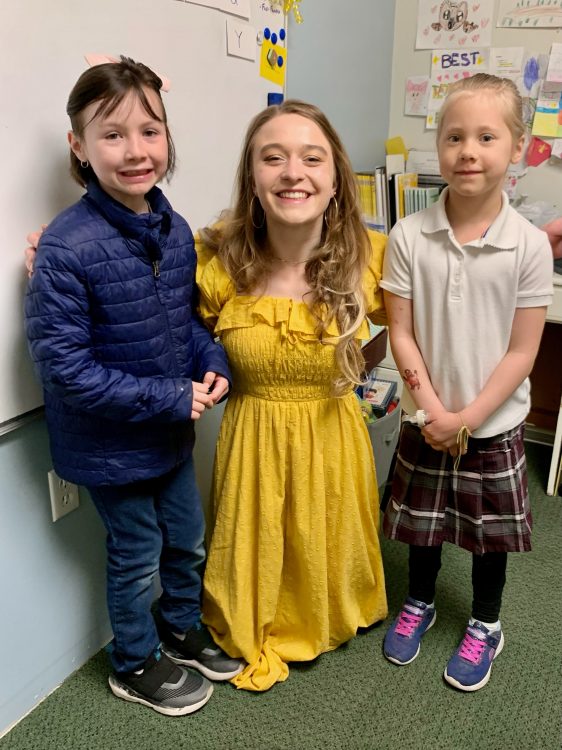
The author's children stand with a teacher in a classroom.

My children have formed relationships with new kids, new families, and new adults — and all of these relationships have blessed them. We have had some disagreements with things they have learned, but each situation we faced provided us with a great opportunity to talk through different ideas and about why we believe what we do.

Instead of being protected at home, they have experienced a world outside their home, one with new thoughts, ideas, personalities, and ways of doing things. They all have made good friends. They each have had tough situations involving friends and learned to work through them. My kids’ world has expanded, and that makes me so grateful.

What Facebook Reminded Me About My Daughter’s Trauma

What Facebook Reminded Me About My Daughter’s Trauma

Nine years ago, back when Facebook was still just a place to share random thoughts, I posted this on my feed:

Lucy’s new trick the past few days is that she cries whenever I leave the room. Instead of annoying me, it makes my heart leap with joy because it means that she is starting to see me as her mommy. Quite a change in perspective from when my boys were babies!” 

The “On This Day” memory popped up and reminded me of those early days with our daughter whom we adopted. She came home to us at almost 6 months old. She was an actual doll with her chubby arms and bouncy brown curls. She stared around at her new mom and dad, new big brothers, and her new home with wide eyes. She stiffened when I picked her up and didn’t hang on to me as my bio kids had at that age. When I set her down on a blanket, she was content to lay there and stare at the ceiling. She didn’t seek our attention. If we entered her field of vision, she would glance at us, then look away. It was eerie.

She didn’t cry much those first few months home. We had no idea when she was hungry because she wouldn’t let us know. I fed her on a schedule so that she got the nutrition she needed.

When kids wake up in the morning or from a nap, there is usually babbling, cooing, crying, or some kind of sound, so the world knows, “Hey people, I’m awake! Come get me!” There wasn’t any of that from our daughter. She was quiet. I would sneak into her room to see if she was awake. Sometimes I would go in, and she would be sitting up in her crib just staring. She didn’t smile when she saw me.

Before coming to our home at 6 months old, she had spent two months in foster care with a sweet older couple that doted on her. Before that, she was with her birth mother. What we know about her history is spotty, but we know she experienced long periods of neglect. 

How Attachment Works

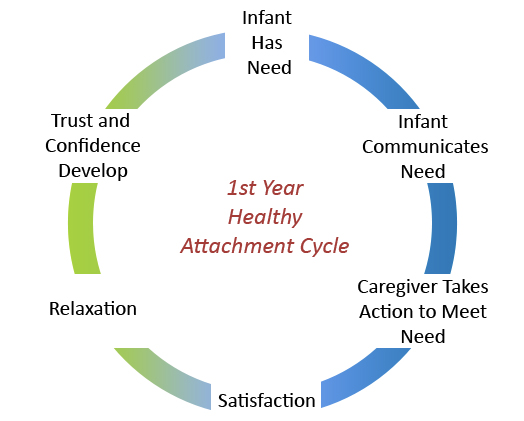
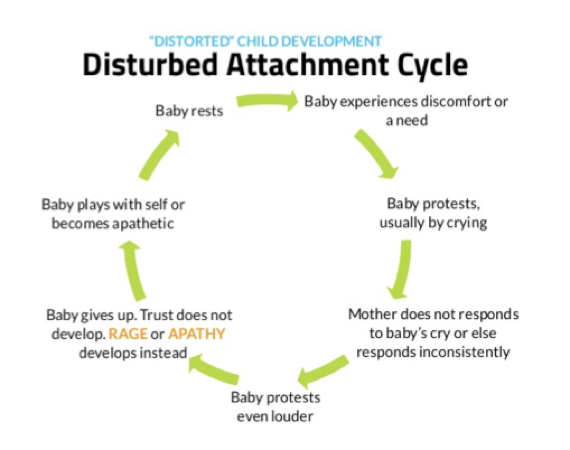
When a baby has a need, they let us know about that need by crying. When they are hungry, they cry until someone comes to feed them. When they are tired, they cry until they are soothed. When they are wet, they cry until someone takes care of their diaper. This is commonly referred to as the attachment cycle. Over and over and over, the cycle is repeated, and the child learns to trust their caregivers.

When that cycle is broken, and a baby’s needs are not met or are met intermittently, it results in the child learning they can’t trust their caregivers. Very likely, at some point in my daughter’s early life, she realized that crying did nothing. No one is going to come, so why bother? “When I’m hungry, no one comes.” “When I’m tired, no one comforts me.” “When I’m wet, no one changes me.” “When I want cuddles, no one cuddles me.” So she gave up and stopped crying to get her needs met. To realize that my daughter went through that process as a tiny baby is heart-shattering. 

What Does Early Trauma Look Like Today?

Today, my daughter is 9. She has intense food insecurities. Thankfully, she no longer has a problem letting us know that she is hungry, but she is always worried that there won’t be enough food or the right food. She is fiercely protective over what she perceives as her food.  It has been a delicate balance to teach her about the foods her body needs to be healthy and allow her to have the foods that make her feel happy and safe.

She also has intense anxiety whenever I leave the house. She is okay going somewhere without me, but if I leave to have dinner with a friend or go on a weekend trip, there is crying and angst for days before. Interestingly, her attitude is no big deal when I return, and she doesn’t act happy that I’m home. 

Dr. Bruce Perry is a child psychiatrist and neuroscientist who has studied the effects of trauma in young children. He writes in his book What Happened to You?, “The basic finding is that the experiences of the first two months of life have a disproportionately important impact on your long-term development. This has to do with the remarkably rapid brain growth early in life. The child who has only two months of horrible experiences does worse than the child with almost 12 years of bad experiences, all because of the timing of the experiences.” 

But that doesn’t have to be the end of the story. As adoptive parents, we have the opportunity to help our children who suffered early trauma and neglect. Here are some ways:

1. Learn as much as you can about trauma and what it does to kids’ brains.

The more we know about their brains, the more we can change how we handle complex issues. When kids’ brains perceive danger, they will operate from their fear response rather than with a rational response. This is why kids sometimes will seem angry when they’re actually scared or stressed.

Some excellent resources that educate parents about their kids’ brains are The Whole-Brain Child by Daniel J. Siegel and Tina Payne Bryson and Brain-Based Parenting by Daniel Hughes and Jonathan Baylin. These will give you the information and the confidence you need to understand your child better.

2. Work on attachment as much as you can when your child first comes home.

If they are babies, this means using attachment practices such as baby-wearing, baby-led feeding, and cocooning, a practice of isolating your family for a time to ensure that you and your spouse are your new child’s primary caregivers. If you bring home an older child, the same concepts can still be used, but in a way that makes sense for an older kid: instead of baby-wearing, you can make a tradition of cozy family movie nights with treats and snuggles if your child allows. 

3. Realize that conventional parenting techniques and discipline may not work with your child. 

When traditional discipline methods are used, which are usually built on a foundation of punishment and consequences, the child’s protection part of their brain is triggered. They switch into fear mode and they can’t learn. Instead, learn about methods like Trust-Based Relational Intervention (TBRI). This approach to parenting helps you reach your child in a way their brain can understand and learn to do things the right way.  A very accessible resource is The Connected Parent by Karyn Purvis and Lisa Qualls. The authors give real-life practical examples of TBRI in practice. When we use gentler methods of discipline where our child feels understood and safe, it is easier for them to learn. After all, discipline is about learning the right way to do things.

Early childhood trauma—even as early as in-utero—damages the brain. The best thing you can do for your adopted child is to understand this trauma. Our end goal should be a good relationship with our children rather than good behavior. The work can take years, but it’s worth it.

Interview with Author Lisa Qualls, Part 1: What Every Parent Should Know Before Adopting

Lisa Qualls is a mother of 12 children through birth and adoption. She and her husband Russ adopted four children from Ethiopia in 2007 and 2008 and have also served as foster parents. Her family has walked through plenty of pain and hardship as well as much joy. Her hard experiences and decades of parenting experience make her a rich source of wisdom.

I first learned about Lisa through her podcast (along with Melissa Corkum) called The Adoption Connection. Her words of hope and grace found me when I was drowning in children and feeling like a massive failure as a mother. I knew my kids needed more from me than what my background in traditional parenting was giving them, but I was at a loss. All I knew was a parenting model based on rules and obedience. But that wasn’t enough.

Lisa’s book The Connected Parent was published in 2020 and co-authored with Dr. Karyn Purvis. It gives parents tools to use with their adopted children and hope for a healthy relationship. I’ve reread this book twice a year since it was published because it is just that practical and helpful.

I recently had the privilege of sitting down with Lisa and asking her some questions about adoption. I think her answers will offer understanding and hope for those looking into adoption or are currently serving in the world of adoption.

Instead of giving an exact account of our conversation (since you don’t need to read my words!) here are Lisa’s own words.

Autumn: So, what do you think adoptive families should know before adopting?

Lisa Qualls:

Be very clear about your purpose in adopting.

First, they should ask themselves what is leading them to want to adopt? We all come to adoption for different reasons. Some people come to adoption because of infertility. Some people see a great need and decide to become foster parents and want to grow their family that way. Others may have a relative who is unable to care for their child and so you begin doing kinship care and then you adopt. So there are so many different reasons that people adopt.

And there is a difference when you are adopting because you feel deeply compelled by God that it’s what you believe you are called to do. So I would want people to be clear with themselves about why they are adopting and then think carefully about it.

Arrive at adoption from a place of fullness, not of need.

Our children’s needs are going to be significant. And if we come unprepared to meet those needs; if we don’t come emotionally healthy, with our marriages stable, with our families somewhat in order (and I don’t mean perfect!)— if you have kids with a lot of behavioral problems or mental health issues, or you’re having a hard time managing the number of needs in your family; that is not the time to adopt.

You have to adopt knowing that you’ve got the capacity because it will take more than you ever think it’s going to. When people come from a place of need or deficit, they’re just not setting their family up to do very well.

We focus on preparing things like the house for the home study. We need to do a lot more work on preparing ourselves. If you’ve got some shaky stuff you need to work out in your marriage, do it. It’s probably not going to miraculously get better once you add the extra ends of more children. Take care of it, get a therapist, and meet with somebody. Get things in order in your home and your family before adding more children.

Surround yourself with other adoptive parents.

I think it’s really smart to surround yourself with other adoptive parents. If you want to adopt or if you’re in the process, get to know adoptive parents and get to know foster parents. We think we know what it’s going to be like. But until you actually know someone who’s an adoptive parent and spend time with people, you really don’t know what the issues or challenges might be. And it’s not all challenges, of course. There’s a ton of joy too, but it can be hard. Like we say in the Hope Circle, “Where we recognize the hard and celebrate the beauty of adoption,” and I feel like that really sums it up. We have to be honest about the hard aspects of adoption while still recognizing the beauty—because it’s both.

Adoption changes everything.

It’s very important for people to know that adoption will change their lives. We can’t expect to be living our life and scoop up a child and adopt them and continue on with our life as we know it—because it will change. Our lives change when we add a child to our family, no matter what, but when you add a child through adoption, there can be layers of complexity because adoption begins with loss. It begins with a family losing a child and a child losing a family.

So we have to understand that kids are deeply impacted. Even newborns are deeply impacted by being separated from their very first mother. And we know that many kids experience other layers of trauma and loss. And so before they’re adopted, before they come to our families—if they’re adopted internationally or if they’re adopted through foster care—they experience layers of loss and sometimes really significant traumas that affect their brain and affect how they view the world and how they view relationships on it.

Be willing to change and grow.

When you adopt, you may have to learn a new way of parenting. You may have to learn a different kind of parenting from your friends’ parenting. Or, if you’re like my family, where you already raised kids and what you did worked, you have to be willing to learn about parenting based on creating connections and building attachment. Because when a child comes to you after having lost their initial attachment figure—let’s say they lived with their biological family for a period of time—those attachments have been broken.

Then they come to you. You’re going to have to parent with attachment and connection in mind. Your goal has to change. My goal used to be obedience. I had to learn that my goal had to be building trust and attachment because true obedience flows from trust and attachment. We can make our children conform (maybe), but true obedience comes out of a desire to please a parent. [. . .]  But without the foundation of trust and attachment, children are not likely to respond to traditional parenting.

Understand that your child’s birth family matters.

If we really believe in the teachings of Jesus, then we have to love our children’s biological families. As we love ourselves, we have to treat them the way we want to be treated and try to see them as much as possible through God’s eyes and not our own. Something led those parents to the point that they could not parent their children, which is very serious. It is not a small thing that someone cannot parent their own child, and whatever led them to that moment had to have been hard.

Some people almost feel a little adversarial, like it’s them vs. us. As Christians, we have to see them as beloved children of God, just like us. And whether we ever have a relationship with them or not, we have to love them and speak of them in the same way we would want to be spoken about. So, that’s not always easy, but it requires us to humble ourselves and overcome some of our fear. As adoptive parents, we’re sometimes afraid of what the birth family might mean to our child—whether our child might love them more or whether or not they’re ever going to be part of our child’s life.

There can be fear. There can be judgement, but let’s follow the most basic command to love the Lord, your God, with all your heart, soul, strength, and mind, and love your neighbor as yourself. Even after being Christian all these decades, I have to pause often and say, “Am I loving that person, as I would love myself?”

With adoption, your child does not come just by themselves. They have other people who have loved them, another mother who has carried them, and those people are present, whether they’re physically present or not.

Faith in God

I think it’s important to have a deep faith and a sure foundation of trust that you are loved by God that your child is loved by God, that God is good, and that He’ll direct you. You know He’ll provide for you, no matter what, in the highs and the lows, in the hard and the good.

You may believe that God is present and that you’re doing what he called you to do. You know, this child was not placed in your family at random. I think that knowledge is important because if we think that we were just randomly given this child, then when things get difficult, I think it’s harder. But if we believe God placed this particular child in my family, because He thought I could do this, then I think that knowledge helps sustain us when things are hard.

———

It was such a pleasure getting to talk with Lisa and hear her thoughts about the hard and beautiful parts of adoption. I hope it has also been encouraging to you. In Part 2, we’ll cover Lisa’s thoughts on how adoption has changed her family and what she wishes outsiders knew about adoption.